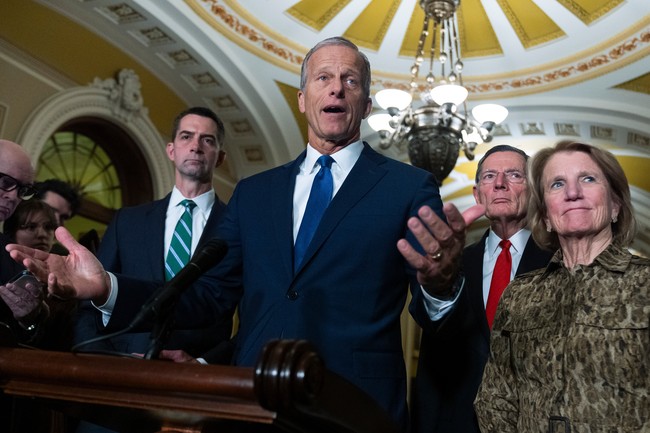
Harry Reid: Destroyer of Worlds


This essay is about several inter-related things: nuclear power, the Yucca Mountain nuclear waste repository, global warming, Earth’s climate, and a carbon tax.  It’s a complex subject, and many at Redstate will disagree with my conclusions.  Those conclusions are tentative, so please provide comments that could change my mind.

I could have chosen a different title for this blog post, like “Uranium is Better than Carbon.”  The reason for picking this particular title is because Senator Reid’s opposition to the Yucca repository in Nevada is apparently a major reason why nuclear power has not flourished in the United States, which in turn is a major reason why the United States is still relying so heavily on fossil fuels that spew carbon dioxide into the atmosphere.

Admittedly, I am not 100% convinced that global warming is occurring, or that it is mostly due to humans if it is indeed occurring, or that it would be harmful for humans to cause global warming.  But I am sufficiently convinced of these things that I favor action to restrain the emission of carbon dioxide into our atmosphere.  My main reason is the same reason why I signed a petition last month to generally ban abortion from conception onward: i.e. being overprotective is far better than being completely unprotective, and being protective is the proper course unless or until there is broad consensus that there is negligible risk of harm.  I will try to prevent other people from playing Russian roulette with unborn children, and with planet Earth, regardless of popularity and regardless of personal consequences.*

Evidently, the only really feasible alternative to fossil fuels is nuclear power.  Wind, solar, geothermal, and other renewable sources are fine, but they are nowhere near enough.  New and better sources of energy may crop up in the future, but we ought not count our chickens before they hatch, and before they even lay any eggs.

It’s worth mentioning that I have absolutely no financial interest in nuclear power, and don’t expect to have any in the future.  This blog post is about public policy, and is about what is best for the planet, and best for the human race.

If the entire world got all its energy from nuclear power, the available uranium in mines would be exhausted within perhaps a decade or so.  However, uranium can also be obtained from seawater, and Japanese scientists have found a way to obtain uranium in that manner costing only three times the current market price.  And my understanding is that the cost of uranium is only a small part of the cost of operating a typical nuclear reactor.  So uranium from seawater could reasonably supply all of humanity’s energy needs for centuries using current technology.

A major impediment to nuclear power in the United States is the consistent failure to establish a nuclear waste repository at Yucca Mountain in Nevada.  The major opponent has been Senate Majority Leader Harry Reid of Nevada.

Some people argue that a waste repository is not really needed, because waste can be reprocessed or stored in above-ground casks.  But, even if those arguments are correct, there are non-trivial counter-arguments that are strongly held by many decision-makers.  Therefore, even if a waste repository is not technologically necessary (I am not taking any position here about that), the lack of such a repository is a practical obstacle to development of nuclear power.  Consequently, it seems extremely worthwhile to placate people who support a repository, even if they are wrong.

I also tentatively support a gradually-increasing tax or fee on carbon-emitting energy sources, if the proceeds are used in only a limited number of ways: reducing the national debt, and/or paying for one or more nuclear waste repositories, and/or direct payments to citizens (note that the state of Alaska has made similar payments).  But I also support abandonment of such a tax or fee if countries like China and India do not make decisive efforts to halt emission of greenhouse gasses within a set time (e.g. four years), or alternatively we could raise tariffs on imports from those countries (i.e. a trade war).  The U.S. can try to lead by example, but without action by countries like China and India we would not succeed in protecting the atmosphere.

As I said, these views are tentative, and persuasive comments of all kinds are welcome.  I have not blogged on this subject before, but feel obliged to do so now, not because I am influential or anything, but because the stakes are enormous.

*Just to clarify: I think that abortion is much more harmful once an embryo becomes a fetus, which occurs about seven weeks after conception. In contrast, the Supreme Court’s dictatorial and unlawful decision in Roe v. Wade purported to make abortion legal up to seven months (“28 weeks”) after conception. I will oppose and protest that foolish and arrogant decision until it is overturned or I am dead, and of course will not vote for any politician whose appointees might support such travesties.


Single Marriage


I am outraged. Single people have been discriminated against and shunted aside for too long. We can be good parents. We pay taxes. We are good citizens. So why can’t each of us be married — to ourself? Why does the state coerce us to shack up with another adult?

If a single person wishes to have sex only with himself or herself, that natural right ought to be respected by the state, instead of deemed a mark of inferiority. It is high time for single people to demand our rights! If I want to join myself in holy matrimony and get a marriage license, it’s barbaric and mean-spirited to get in my way. So get the heck out of my way, dammit!!! You’re all bigots.

While this blog post is satirical, I’m sure there must be a serious point in here somewhere.


The Due Process Plank


An article of mine has just been accepted for publication by the Seton Hall Law Review, and I thought it worth mentioning here. The full text is available for free at SSRN, and here is the abstract:

The Republican Party’s national platform of 1860 is useful for interpreting the Fourteenth Amendment of the U.S. Constitution, which was written just six years later by a Republican-controlled Congress. However, the platform is frequently misunderstood. The due process plank of the platform is often portrayed as supporting the doctrine called substantive due process, but a close look at the platform shows that it did not actually support that doctrine. The due process plank aimed to protect liberty in free federal territories, rather than in areas like the District of Columbia where substantive due process would have applied equally. Congress largely stopped supporting slavery 150 years ago, in 1862, but not because of any substantive penumbra of the Due Process Clause.

It’s not only an interesting historical subject, but also has ramifications for modern-day constitutional law.


Veepstakes


Columnist George Will recently said: “If Jeb Bush is to be Romney’s running mate, it would mean that in seven of nine presidential elections there would be a Bush on the Republican ticket…. And it gets hard to argue that we’re not a tribal society at that point.”

I don’t know who Romney ought to pick, but it seems messed up to rule out someone because of his last name. If picking the best person is the goal, then name-ism could get in the way of that goal. And why try to read qualifications into the 22nd Amendment that aren’t there? Jeb Bush has not served two terms in national office, so he’s eligible.

Suppose that Jeb Bush not only is elected Vice-President, but also eventually serves two terms as president (a HUGE assumption). The Bushes would STILL have not exceeded the approximately twenty years that the Roosevelts served as president. Teddy Roosevelt served almost two full terms, and FDR served a little bit more than three full terms.

In the current Veepstakes, there are many solid contenders from a variety of backgrounds. Jeb Bush is one.


Rambling Thoughts About Wikipedia


Wikipedia has the top search results for an incredible number of topics. Its goal is not to make money, but it has something close to (or analogous to) a monopoly on the valuable service that it provides.

So it’s interesting to consider how that organization is governed. And make no mistake, Wikipedia is not some “just the facts ma’am” encyclopedia. Rather, for many controversial subjects, it’s an information filter that Wikipedia’s government greatly influences. And, yes, like all corporations, Wikipedia has a government.

There are ordinary editors at Wikipedia, and there are also administrators. Many of the editors and administrators are excellent, but some of them collude, and use the Wikipedia government to slant information, mostly by pursuing editors who they choose to bring actions against. As volunteers, these administrators are not required to take action against anyone, so they can solely enforce rules against those whom they choose to target, or alternatively can take only token action against those with whom they agree about article content.

The ultimate authority at Wikipedia, or at least the penultimate authority, is the “Arbitration Committee” (aka “ArbCom”), which is often too busy or uninterested or biased to be anything but a rubber-stamp for whatever lopsided or unsubstantiated action the administrators may take.

The ArbCom says what the facts of a dispute are, and what the rules are. There is no involvement of ordinary editors as randomly selected “jurors” or the like. And since anonymity prevails, there is not much of any way to prevent or obtain correction of slanderous, or libelous, accusations or decisions made during “dispute resolution” by the administrators or by “arbitrators” (the arbitrators are the members of ArbCom, numbering less than twenty).

ArbCom is heavily influenced by Jimmy Wales, the founder of Wikipedia, whose personal discussion page in some ways operates as the pinnacle of the encyclopedia (in the sense that the most powerful Wikipedians monitor that discussion page and take their cues from it). In this pyramid-like structure, enormous influence is wielded from the top down, and ordinary editors do not make any of the fact-finding decisions during the adjudication of disputes by ArbCom. While bureaucracy may be inevitable in such a large enterprise, there is a centralization of power that coexists with more inclusive power mechanisms. In other words, ordinary editors can participate in policy-making and elections at Wikipedia in a large number of ways, and this tends to conceal (or mask) the more top-down aspects of the operation.

What Wikipedia needs most is to create something like a jury system so that randomly-chosen editors can perform many functions that are currently performed by cliques. That includes (at least) fact-finding during disputes, and ought to include many other functions as well. Can you imagine what would happen if real-life criminal juries were replaced by whoever decides that they’d like to show up, or alternatively replaced by a bunch of permanent officials? Either way would be a disaster, and yet that is pretty much what Wikipedia has done.

Wikipedia is a non-profit, and supposedly non-political entity. It is certainly a good first-stop resource on many topics. But its governance needs to incorporate basic elements that have been used in civil governance for thousands of years, such as randomly-selected and mandatory jury duty.


Iran


Here’s my prediction for where the Iran situation is going. Israel has a more limited ability to strike, and so the United States can wait longer. On this basis, the U.S. will persuade Israel to wait, and the U.S. will then be the only force that could stop Iran from getting the bomb. The U.S. will say that all options are on the table, and say that sanctions need more time, et cetera. Then Iran will do an above-ground nuclear test, Obama and Panetta will say “oops we waited too long”, and the head of the CIA or NSA will be fired.

That seems like the most likely scenario to me. It’s not a very pretty scenario, nor is it a complete scenario, inasmuch as it omits what happens next (e.g. nuclear arms race in the Middle East, possible Iranian attack on Israel, possible handoff of nukes to terrorists, etc.). The other alternative scenarios look kind of scary too, such as a pre-emptive war with Iran.

Syria is a close ally of Iran, and it’s hard to believe that what’s happening in Syria now is merely coincidental with the confrontation with Iran regarding nukes. If Assad were forced out, that would probably have a bigger impact on Iranian decision-making than any sanctions placed on Iran.

Leon Panetta and Hillary Clinton seem competent, and General Petraeus (DCI) is extremely competent. But competence may not be enough in this instance. I’m not making any specific suggestions or recommendations here, because I don’t have all the facts.

Among the pertinent facts are what exactly the Iranian leaders have said they want to do to Israel, and vice versa. If the Iranians are clearly making unprovoked threats of annihilation, then it would be foolish to not act preemptively against Iran. But the costs of preemptive action could be pretty staggering.

Forget about economic sanctions and negotiations. I doubt they’ll make any difference.

President Obama has not been prepping the American people, nor has he been insisting on much action by the United Nations. So, the costs of action against Iran have not even been factored into the stock market, much less into Iranian decision-making.

Iran has said that it would be sinful to develop nuclear weapons, but doubtless they could rationalize doing so based on others (like Israel) having done so.

There are about a dozen wildcards here, ranging from a possibly imminent attack by Israel, to use of nuclear weapons by the U.S. or Israel to adequately penetrate underground Iranian facilities.

Iran would be smart to allow full transparency. They have no immediate need for nuclear weapons. Their arch-enemy Sadaam has been removed from Iraq, and the US has left Iraq too. Israel is a tiny country that poses no threat to Iran if Iran sticks with conventional weapons. But don’t count on rationality in Teheran.

The situation in North Korea is a troubling precedent for proliferation. China seems largely responsible for that fact, and China (with Russia) has also blocked UN action against Syria. I don’t see why China thinks it is in its interest for lots of unstable countries to have nuclear weapons. And journalists in China are not likely to press their leaders for answers on that score. Maybe what we need here is for Anderson Cooper and Brett Baier to go camp out at the Forbidden City until they get some answers.


Endorsing Romney for Florida


In the recent GOP primary campaign in South Carolina, Sarah Palin urged people to vote for Newt Gingrich in that particular primary, in order to keep the overall primary battle competitive. I now offer my not-much-sought-after endorsement to Romney for the Florida primary, for the same reason. If Romney loses Florida, his campaign would collapse. If he wins, it’s still competitive.

I am not 100% sold on Romney as the nominee. Not even 75%. But I hope Floridians vote for him.

The main objection to him has been RomneyCare. But keep in mind that he was dealing with a veto-proof Democratic majority in the legislature. If he hadn’t sought compromise, the resulting legislation would have been WORSE. Why he has not emphasized this point I do not know. But it’s true. And you know what else is true? Romney continues to poll a lot better against Obama than Gingrich does. ‘Nuf said.


How to Save a Few Hundred Billion


I don’t like ObamaCare, nor the idea that the federal government can order citizens to buy things (like insurance) from other citizens, nor do I appreciate the takeover of state authority in the area of health insurance by centralized federal bureaucrats in DC. ObamaCare is rightly being challenged in court as unconstitutional. But for now, at least, it’s on the books, and it will cost tons of federal tax money.

One way to streamline ObamaCare immediately might be for Congress to limit it to catastrophic health care coverage; i.e. it should only cover a person’s expenses for care that would have been offered according to pre-ObamaCare federal law at hospitals without regard to inability to pay. In other words, immediately limit ObamaCare to stopping freeloaders. That could, it seems to me, save taxpayers a ton of money immediately, regardless of whether ObamaCare is eventually held unconstitutional.

This is just an outline of a hunch. I’m not an expert on health care or the federal budget. But wasn’t a primary Democratic rationale for ObamaCare to stop people from freeloading? Why not use that rationale as a limiting principle, to trim billions from the federal budget?


Will RomneyCare Cripple Romney?


It may be a bit early to be thinking about the 2012 election. Election campaigns definitely need to be shorter, but that’s not yet the way it is, so here are a few thoughts specifically about RomneyCare and Romney….

The recent federal law requiring an “individual mandate” for people to go out and buy health insurance is enormously unpopular with conservatives. It seems to me that there are two arguments that Romney can make about the individual mandate in RomneyCare, and both arguments can be made at the same time.

First, it’s a federalism issue, and he never supported an individual mandate ordered by Congress, as far as I know.

Second, even before RomneyCare and ObamaCare, everyone in Massachusetts was effectively insured against catastrophic health costs, in the sense that hospital emergency rooms were barred by federal law from turning away people who lacked private insurance. So, some form of statewide individual mandate is appropriate to relieve taxpayers of that burden. The individual mandate in RomneyCare did that. But it also did more, and therein lies a potential problem for Romney.

He may be the GOP’s most electable guy, so from a pragmatic point of view I hope he can address this issue early on, and (if he can) get it out of the way.

By the way, this is my first blog post straight from my smart phone. The telecommunications revolution is truly amazing.


What Does “Subject to the Jurisdiction Thereof” Mean in the 14th Amendment?


The leading case is United States  v. Wong Kim Ark.  That case involved parents who were in the U.S. legally when they had a child (i.e. they had “permanent domicile and residence” in the U.S.), so it’s not directly on point regarding birthright citizenship for illegal aliens.  However, the Court in Wong Kim Ark gave some big hints.  The Court in Wong Kim Ark stated that:

“The words ‘in the United States, and subject to the jurisdiction thereof,’ in the first sentence of the fourteenth amendment of the constitution, must be presumed to have been understood and intended by the congress which proposed the amendment, and by the legislatures which adopted it, in the same sense in which the like words had been used by Chief Justice Marshall….”

The prior opinion by Chief Justice John Marshall was The Exchange v. McFaddon. Here’s an excerpt from John Marshall’s opinion in that case (emphasis added):

When private individuals of one nation spread themselves through another as business or caprice may direct, mingling indiscriminately with the inhabitants of that other, or when merchant vessels enter for the purposes of trade, it would be obviously inconvenient and dangerous to society, and would subject the laws to continual infraction and the government to degradation, if such individuals or merchants did not owe temporary and local allegiance and were not amenable to the jurisdiction of the country. Nor can the foreign sovereign have any motive for wishing such exemption. His subjects thus passing into foreign countries are not employed by him, nor are they engaged in national pursuits. Consequently there are powerful motives for not exempting persons of this description from the jurisdiction of the country in which they are found, and no one motive for requiring it. The implied license, therefore, under which they enter can never be construed to grant such exemption.

So, it’s not 100% clear from this how Marshall (or the Court in Wong Kim Ark) would have approached the issue of birthright citizenship for illegal immigrants.  But, we have two important criteria that Marshall mentioned: (1) continual infractions of the law, and (2) license to enter.  Obviously, illegal immigrants have no license to enter, and granting automatic birthright citizenship is obviously an incentive for continual infraction of the laws.

The Supreme Court precedents specifically say that children of foreign diplomats, and also children of occupying forces, are not subject to the jurisdiction of the United States, and do not automatically get U.S. citizenship upon birth.  I don’t think that it would be a huge problem for Congress to treat illegal immigrants like foreign diplomats who are not subject to the jurisdiction of the United States; for example, the individual states would still have full jurisdiction, even though the federal government would not.  In any event, even if Congress does not want to treat illegal immigrants more like foreign diplomats, still the factors described by Chief Justice Marshall suggest that they fall within the 14th Amendment’s jurisdictional exception.

I previously made some of these observations in a comment thread, but thought I’d make a full diary post out of them.


Ninth Circuit Judge William Fletcher: Conservatives Who Propose Constitutional Amendments to Deal With Gay Marriage and Abortion are Ignoring a Much Easier Solution


Can Congress strip the federal courts of power to decide some federal legal questions, like whether gay marriage or abortion are fundamental rights under the Fourteenth Amendment?  The answer is “yes”, according to an article earlier this year in the Duke University Law Review by Federal Ninth Circuit Judge William Fletcher. I emphatically agree with Judge Fletcher that Congress can indeed allow the courts of a particular state to make a final decision about whether a particular type of state statute violates the federal Constitution.

Article III, Section 2 of the Constitution says that, “The [federal] judicial power shall extend to all cases, in law and equity, arising under the Constitution, [and] the laws of the United States….” (emphasis added).  This is the source of the federal courts’ jurisdiction over federal questions. At first glance, this extension of federal question jurisdiction to “all cases” would seem to mean that Congress cannot withdraw some federal question cases from the federal judiciary.  However, such a hasty conclusion would be flat wrong.

Judge Fletcher points out that the word “all” in this sentence of the Constitution was intended to allow Congress to strip state courts of jurisdiction over some cases (e.g. federal question cases), whereas the Constitution’s omission of the word “all” in relation to other cases (e.g. diversity controversies) disallows Congress from stripping state courts of jurisdiction.  Thus, according to Judge Fletcher, inclusion of the word “all” in Article III, Section 2 expands congressional power with respect to state courts, instead of shrinking congressional power to create exceptions to the federal question jurisdiction of the federal courts.

There are several textual features of the Constitution that I would like to now point out in support of Judge Fletcher’s argument that the word “all” in Article III, Section 2 does not forbid Congress from making exceptions to federal question jurisdiction with respect to the federal courts.  Keep in mind that such exceptions would make those particular federal questions subject to final decision in the state courts.

The first textual feature that provides additional support to Judge Fletcher’s argument is that the Constitution repeatedly discusses “cases of impeachment”, as an exception to federal judicial power over federal questions.  If those cases were not an exception to federal judicial power, then the Senate would have to be an inferior court whose members serve for life, given that all federal judicial power must be vested in the Article III courts.

The second textual feature supporting Judge Fletcher is that Article III, Section 2 does not include the word “whatsoever” as does Article I, Section 8 which gives Congress power over the District of Columbia “in all cases whatsoever.”  When the framers wanted to be categorical, they knew how.  If they had wanted to prevent Congress from making any exceptions to the federal judiciary’s jurisdiction over federal questions, they would have said “all cases whatsoever” instead of merely “all cases”.

A third textual feature in support of Judge Fletcher’s position is the Exceptions Clause, which plainly allows exceptions to federal appellate jurisdiction for federal question cases.  The only way to maintain federal jurisdiction over those particular federal question cases would be by giving the Supreme Court original jurisdiction over those cases.  However, Congress cannot expand the original jurisdiction of the Supreme Court.  The canon of exclusio unius indicates that the Supreme Court’s original jurisdiction only extends to ambassadorial-type cases plus state-party cases (described in the first sentence of Article III, Section 2).

To my mind, these textual considerations strongly buttress Judge Fletcher’s argument.  No recourse is necessary to the private intentions or the secret deliberations of the framers, or to congressional activity after ratification, or to U.S. Supreme Court precedent, or to legislative practice, or to the vast number of law review articles that have been written on this subject.  The text of the Constitution is clear that Congress can make exceptions to the federal question jurisdiction of the federal courts.

As Judge Fletcher emphasizes in his closing paragraph, the failure of Congress to do anything simply amounts to an endorsement of what the U.S. Supreme Court has done: “if Congress has the power to strip the federal courts of their jurisdiction, and if it chooses to leave their jurisdiction undiminished, Congress has to that degree in turn accepted and legitimized the exercise of judicial power.”

UPDATE (October 23, 2010): Just thought I’d mention the following line from the Supreme Court’s opinion by Justice Joseph Story in Martin v. Hunter’s Lessee, 14 US 304 (1816): “The judicial power shall extend to all the cases enumerated in the constitution.   As the mode is not limited, it may extend to all such cases, in any form, in which judicial power may be exercised” (emphasis added).  One could argue that no judicial body can exercise power in cases of impeachment, and so those cases are not an exception to the judicial power granted to the federal courts.

On the other hand, Federalist 83 says: “the judicial authority of the federal judicatures is declared by the Constitution to comprehend certain cases particularly specified. The expression of those cases marks the precise limits, beyond which the federal courts cannot extend their jurisdiction, because the objects of their cognizance being enumerated, the specification would be nugatory if it did not exclude all ideas of more extensive authority.”  That’s similar to what the Supreme Court held in Marbury v. Madison, which seems to contradict the argument (by some scholars who believe stripping the federal courts of jurisdiction is unconstitutional) that congressional exceptions to the Court’s appellate jurisdiction signify that the Court instead has original jurisdiction over those excepted cases.

Anyway, this is certainly not a simple issue, and I’ve got an open mind about it, though I still think that Judge Fletcher is correct.


The California Gay Marriage Case is a No-Brainer for the Ninth Circuit


Almost everyone (and his or her “significant other“) has already written about Judge Walker’s gay marriage opinion.  But I haven’t yet, so I’ll just address what seems to me to be the main point: the people of California have decided not to treat “domestic partnerships” one iota differently than “marriages”, and so Judge Walker is merely complaining about the words that the people of California have chosen to use.  That is nuts.  The people of California have a right of free speech, both as individuals and collectively, and they can call gay people “gay” and gay couples “domestic partnerships”.  Judge Walker wrote as follows in Perry v. Schwarzenegger:

California has created two separate and parallel institutions to provide couples with essentially the same rights and obligations. Cal Fam Code § 297.5(a)….California allows almost all opposite-sex couples only one option —— marriage —— and all same-sex couples only one option —— domestic partnership. See id, FF 53-54.  The evidence shows that domestic partnerships do not fulfill California’s due process obligation to plaintiffs for two reasons. First, domestic partnerships are distinct from marriage and do not provide the same social meaning as marriage.  Second, domestic partnerships were created specifically so that California could offer same-sex couples rights and benefits while explicitly withholding marriage from same-sex couples.

So, this case has nothing to do with any substantial rights, and is all about nomenclature.  Which, as I said, is nuts.  The people of California can collectively speak as they please.  Do you think this may be about something more than free speech?  Think again.  Last year, the California Supreme Court (by a vote of 6-1) wrote as follows in Strauss v. Horton :

The Attorney General’s contention … rests inaccurately upon an overstatement of the effect of Proposition 8 on both the fundamental constitutional right of privacy guaranteed by article I, section 1, and on the due process and equal protection guarantees of article I, section 7. As explained below, Proposition 8 does not abrogate any of these state constitutional rights, but instead carves out a narrow exception applicable only to access to the designation of the term “marriage,” but not to any other of “the core set of basic substantive legal rights and attributes traditionally associated with marriage . . .”

Ah, but you still doubt that the people of California have a collective right to speak as they wish?  Well, aside from the plain text of the First Amendment, consider what the U.S. Supreme Court said in another case last year (Pleasant Grove v. Summum):

A government entity has the right to “speak for itself.”  Board of Regents of Univ. of Wis. System v. Southworth, 529 U.S. 217, 229 (2000). “[I]t is entitled to say what it wishes,” Rosenberger v. Rector and Visitors of Univ. of Va., 515 U.S. 819, 833 (1995) , and to select the views that it wants to express. See Rust v. Sullivan, 500 U.S. 173, 194 (1991) ; National Endowment for Arts v. Finley, 524 U.S. 569, 598 (1998) (Scalia, J., concurring in judgment) (“It is the very business of government to favor and disfavor points of view”).

Indeed, it is not easy to imagine how government could function if it lacked this freedom.

So, basically, this case should be a slam dunk on appeal.  Emphasis on “should”.  When plaintiffs start arguing about “substantive due process”, many judges are apt to do whatever they think is best, and all bets are off. 

This would be a much more interesting case if the state were actually treating marriages differently from domestic partnerships, and doubtless that issue will eventually percolate up to SCOTUS from another state.  When that time comes, I will probably argue that – yes – the state does have a legitimate interest in ensuring that a child has a mother and father if that is feasible, and also in encouraging biological parents to bring up their children.  It is true that those two goals can sometimes conflict with each other, and it is also true that gay couples can sometimes be better parents than straight couples, but still I think those two goals are legitimate and worthy.  And even if I’m wrong about that (unlikely!), still the U.S. Constitution was not meant to give judges unlimited power to strike down every law that the judges think is illegitimate or unworthy.


An Example of Why Every Democratic and Republican Senator Should Vote Against Confirmation of Goodwin Liu


Over at the Bench Memos Blog, Ed Whelan has been carefully analyzing the nomination of Goodwin Liu for the Ninth Circuit Court of Appeals.  I have not taken the time to look at all of his blog posts, much less all of the material available about Liu.  I do not need to.  One incident alone amply confirms that this person is not qualified to be a judge, much less has the temperament to be a U.S. Circuit Court Judge.

Several years ago, Professor Liu testified during the confirmation hearings of Justice Alito.  So far so good.  Many people who testified against Justice Alito’s nomination would doubtless be well qualified for the federal judiciary.  But here is one of the belligerent, demagogic, and dishonest statements that Professor Liu made at that time:

Judge Alito’s record envisions an America where police may shoot and kill an unarmed boy to stop him from running away with a stolen purse….

This statement by Liu shows him to be nothing but a pure partisan hack, more interested in demonization than in telling the truth.  What Alito actually said was that statutes can stop policemen in such situations, even though the Constitution is silent about it.  Alito wrote about the policeman in this situation:

If he did not shoot, there was a chance that a murderer or rapist would escape and possibly strike again.  I do not think the Constitution provides an answer to the officer’s dilemma.

If Professor Liu had been the slightest bit interested in conveying truthful information to the Senate, he might also have noted that three justices of the U.S. Supreme Court subsequently agreed with Alito’s position in this case, namely Justices O’Connor, Burger, and Rehnquist.  But of course a lunge for the jugular rarely includes a calm and dispassionate portrayal of facts.

According to Alito, statutes regarding fleeing felons are, “based upon difficult moral and philosophical choices and a balancing of values that is peculiarly suited for legislative rather than judicial resolution.”  According to Liu, deferring to the legislature means supporting the worst possible thing that the legislature could possibly do; expect no deference from him.

Professor Liu also testified that he found it “chilling” for Alito to write the following words about this case:

If every suspect could evade arrest by putting the state to this choice [of shooting versus allowing escape], societal order would quickly break down.

Alito was 100% correct, and Liu is out of his mind.  Please do not confirm a judge who would allow every suspect, including known rapists and murderers, to flee from arrest.

I have not said a word against Obama’s other nominees, but this one really stands out from the crowd.  I am not advocating a filibuster here (though it would be much more deserved than the filibusters of Bush’s nominees), but am advocating a vote not to confirm.


End Birthright Citizenship for Illegal Immigrants


George Will has an excellent column today urging Congress to end automatic birthright citizenship for illegal immigrants.  Bravo.  Legal immigration from Mexico and other countries is wonderful, but illegal immigration continues to have a huge negative impact on our country.  Comprehensive immigration reform legislation is likely this spring, and any meaningful legislation will get rid of automatic birthright citizenship.  George Will quotes a recent law review article by Lino Graglia:

It is difficult to imagine a more irrational and self-defeating legal system than one which makes unauthorized entry into this country a criminal offense and simultaneously provides perhaps the greatest possible inducement to illegal entry.

Most Americans are sick and tired of futile half-measures to stop illegal immigration, such as the recently-abandoned “virtual fence” at the southern border.  There are effective steps that Congress could take, and eliminating automatic birthright citizenship is at the top of the list, even though it raises some legitimate constitutional concerns.  As George Will’s column today points out, those concerns are not convincing.

Accordingly, in order to get the ball rolling, allow me to draft some statutory language that would get the job done:

SECTION 1. SHORT TITLE.

This Act may be cited as the “Birthright Citizenship Act of 2011″.

SECTION 2. CITIZENSHIP AND JURISDICTION WITH RESPECT TO CERTAIN PERSONS.

(a) Congress hereby finds and declares as follows.

(1)  Legal immigrants have always been welcome here in this country, and always ought to be welcome here.

(2)  Automatic birthright citizenship for newborn children of illegal immigrants has provided an inducement to illegal entry, and has thereby subjected the laws to continual infraction and the government to degradation.

(b) Be it enacted by the Senate and House of Representatives of the United States of America in Congress assembled, pursuant to authority under Article I, Section 8 and Article III, Section 2 and also Amendment XIV, Section 5 of the Constitution:

(1)  The federal courts shall not have jurisdiction over any person barred from lawful presence in this country, nor any newborn child born in the United States with parents barred from lawful presence in this country, to any greater extent than the federal courts have jurisdiction over foreign diplomats.

(2)   Executive branch officials shall deem the residence of any person barred from lawful presence in this country, and the birthplace of a newborn child born here with parents barred from lawful presence in this country, equivalent to a diplomatic compound or occupied territory for purposes of determining federal jurisdiction.

(3)  A newborn child, born here with parents barred from lawful presence in this country, shall not have a different citizenship or nationality than those of his or her parents.

(4)  Persons barred from lawful presence in this country shall have a continuing duty to respect the laws of the United States, and executive branch officials shall have authority to declare whether such a person is persona non grata and shall also have authority to revoke or restore the immunity of such a person from federal prosecution on a case by case basis in the event of deportation, or in the event of reentry, or in the event of consent from the person’s home country, or in the event that effective prosecution reasonably appears unlikely in the home country.

(5) Section 301 of the Immigration and Nationality Act (8 U.S.C. 1401) is amended–

(i) by inserting “(a) IN GENERAL- ” before “The following”;

(ii) by redesignating paragraphs (a) through (h) as paragraphs (1) through (8); and

(iii) by adding at the end the following:

“(b) Definition- Acknowledging the right of birthright citizenship established by section 1 of the 14th amendment to the Constitution, a person born in the United States shall be considered ‘subject to the jurisdiction’ of the United States for purposes of subsection (a)(1) if the person is born in the United States of parents, one of whom is at the time of birth–

“(1) a citizen or national of the United States; or

“(2) an alien not barred from lawful presence in the United States, and not having diplomatic immunity.”

(iv) In case of an irreconcilable variance between the other portions of this act and the Constitution, then, at minimum, these changes to the United States Code shall remain in force.  Additionally, the other preceding portions of this act shall not be held effective except to the extent necessary to render constitutional these changes to the United States Code.

(6) Nothing in this act shall affect any of the legal rights or privileges that are owed equally to persons irrespective of citizenship, according to either state or federal law, or both.

(7) Nothing in this act shall affect the jurisdiction that any state government may have over any person at any time.

(8) Nothing in this act shall affect the citizenship or nationality status of any person born before January 1, 2011.

(9) Nothing in this act shall diminish the ability of the federal government to expel any person, including diplomats and other persons described in this act.

(10) Nothing in this act shall affect eligibility for naturalization, nor shall affect jurisdiction over persons who are naturalized.

Any congresscritters listening?  :-)

UPDATE (3/31/2010):  For those of you who have not read the Graglia article linked above, Professor Graglia argues that “subject to the jurisdiction thereof” in the Fourteenth Amendment originally meant “not subject to any foreign power” or alternatively “not owing allegiance” to any other country.  Therefore, Graglia suggests, a latter-day Dred Scott would be entitled to citizenship, whereas an infant child of illegal immigrants would not.  This issue has never been squarely presented to the U.S. Supreme Court.  I’ve tweaked the draft statute above to make it a little better, in view of the currently pending H.R. 1868.

UPDATE #2 (4/7/2010): I just want to add that I do not agree with Graglia and Will on one point: to the extent they argue against a constitutional right of birthright citizenship for children of legal resident aliens, that seems incorrect.  And to the extent they argue that the Wong Kim Ark case was wrongly decided, I disagree with that too.  What I agree with them about is that newborn children of illegal immigrants do not necessarily have a constitutional right to birthright citizenship.  It is very important not to get legal immigrants mixed up with illegal immigrants.


States Sue Uncle Sam Regarding Health Care


Here’s the complaint filed by fourteen states today against the federal government.  Virginia will be filing a separate lawsuit.

Regarding the new law’s “individual mandate” that people must buy government-approved health insurance, I think there’s a decent chance that the Supreme Court might strike it down.  If the Court does so, I doubt the Court would even have to address how much power Congress has under the Commerce Clause of the Constitution.  Instead, the Court could simply say that Congress made a mistake by including an unconstitutional “capitation” in this legislation (a capitation is a tax on the person rather than a tax on property), and the Court could kindly invite Congress to correct this mistake.  Alas, the Senate might lack the votes to do so.

Here’s a summary of the individual mandate penalty:

Senate bill: Those without insurance would pay either $750 per year per person up to $2,250 per family or two percent of household income, whichever is greater. It would be phased-in: $95 in 2014, $495 in 2015, and $750 in 2016 or point-5 percent of taxable income in 2014, one percent of taxable income in 2015, and two percent of taxable income in 2016.

Reconciliation bill: The individual penalty would be reduced from $750 to $695, but the alternative penalty on households would increase. The household income assessment would change from point-5 percent to one percent in 2014, one percent to two percent in 2015, and two percent to 2.5 percent for 2016 “to make the assessment more progressive.”

There is also an exemption for people who fall under the tax-filing threshold or who would end up spending more than 8 percent of their annual income on health insurance.  However, I don’t think it would be proper to look at exemptions in order to determine the character of a tax itself.  Moreover, suppose that Congress imposes 1000 separate flat taxes on each person in the country, and each of those 1000 taxes has an exemption if it would exceed 8% of income.  Surely that cannot render all of the 1000 taxes an income tax, because the tax could total up to 8000% of income.

The Constitution says:

[D]irect Taxes shall be apportioned among the several States which may be included within this Union, according to their respective Numbers (Article I, Section 2)

No capitation, or other direct, Tax shall be laid, unless in Proportion to the Census or Enumeration herein before directed to be taken (Article I, Section 9).

The Congress shall have power to lay and collect taxes on incomes, from whatever source derived, without apportionment among the several States, and without regard to any census or enumeration (Sixteenth Amendment).

The Supreme Court has written the following about the Sixteenth Amendment, In the case of Eisner v. Macomber):

[T]his amendment shall not be extended by loose construction, so as to repeal or modify, except as applied to income, those provisions of the Constitution that require an apportionment according to population for direct taxes….This limitation still has an appropriate and important function, and is not to be overridden by Congress or disregarded by the courts.

So, if the Court now says that the individual mandate penalty is a capitation, then Congress could of course change the penalty, e.g. to say that it is a one percent increase in the income tax you owe.  Normally, this would be a technicality that Congress could easily correct — if there were 60 votes in the Senate who wanted to correct it.

It’s worth keeping in mind that none of these federal constitutional provisions prevent a state from having an individual mandate to buy health insurance.  Also, I doubt that these constitutional provisions even affect the federal government’s ability to have an individual mandate where federal power is plenary, e.g. within the city limits of Washington D.C.  Additionally, I don’t think that an individual mandate is necessarily a bad thing on policy grounds, because uninsured people can cost a state lots of money when they show up at hospitals sick or injured.  But still the federal government must comply with all applicable constitutional provisions, including the one regarding capitation taxes.


The Demise of Obamacare


The health care plan that Congress recently approved requires people to buy insurance. That’s the whole basis of the thing. That way, people cannot avoid insurance until they get sick or injured, and cannot thus take advantage of the new ban on turning away people with pre-existing conditions.

So, the requirement to buy insurance is a central feature of Obamacare.  And, that feature will be the main target of the constitutional challenge in court.

All the same, there are some things in the new health care legislation that I like.  For example, I like that health insurance will become more portable, meaning that people who leave a job will be able to keep themselves covered, and therefore will not lose coverage for a pre-existing condition.  I hope that the GOP will offer a replacement health care plan, in the event that Obamacare is repealed or overturned, that includes this feature.

Here at Redstate, Erick says: “any Republican who says we will repeal and replace will themselves be replaced.  We want repeal period.”  But National Review has a different stance: “Conservatives will be able to capitalize on the discrediting of Obamacare, however it takes place, only if they campaign this fall on a pledge to replace this government-heavy system with true reform.”  I think National Review is right.

It will be interesting to see how things develop over the next few days in Congress.  One thing I’m hoping for is that both houses will quickly pass legislation repeating all the stuff in the executive order that Congressman Stupak obtained from President Obama.


A Trend Toward Sanity Continues: The Vote On The Senate Bill Will Precede Any Vote on Reconciliation


According to the Daily Caller:

[T]here were reports that Steny Hoyer said earlier Saturday that the House would vote on reconciliation first Sunday, and then on the Senate bill. This isn’t really all that big of a deal but apparently some Democrats wanted to vote in that order to symbolize their preference for the reconciliation legislation over the Senate bill.  But I’ve confirmed with House leadership aides that the House will vote on the Senate bill first, and then the reconciliation legislation.

That is somewhat good news.  It’s a cliffhanger, and the toughest vote will come first.  This is as it should be, for many reasons, not least of which is that it would be crazy to vote to amend a bill and then vote on the bill itself without the amendments.

Meanwhile, according to The Hill, 36 Democrats 37 Democrats are leaning no, likely no, or firm no.  38 Democrats are needed to kill the bill, and start over with a clean slate on a bipartisan basis.  20 Democrats 19 Democrats are undecided or unclear.

Hat Tip: Patterico’s Pontifications.


Speaker Pelosi Now Commits to a Straight Up-Or-Down Vote to Enact the Senate Health Care Bill, Including the Cornhusker Kickback and All the Rest


The illegal “deem and pass” Slaughter Solution is now officially dead.  Tomorrow (Sunday), the House is scheduled to first vote on the Reconciliation Bill, which would not become law unless and until it is approved by the Senate.  The House would then vote on the Senate Bill which would become law immediately upon being signed by the President.

By voting on the Reconciliation Bill first, it appears that the later vote on the Senate Bill would amend the Reconciliation Bill, which is kind of bizarre.

So, now we have to wait and see whether Democratic House members are willing to unambiguously vote for the Cornhusker Kickback, the NARAL-demanded abortion language, and all the other obnoxious stuff in the Senate Bill.  Some of that stuff would probably be removed during the reconciliation process, but that’s not a sure thing.  We’ll see whether House members really want to go on record in support of it, before it is removed.

The House Democratic leadership deserves some credit for switching away from a clearly unconstitutional procedure.  But the Senate Bill has been enormously objectionable to most Democrats and Republicans, so it may not get as much support on the House floor as it would have gotten in combination with the Reconciliation Bill.  We’ll see.

The procedure that they’re now going to use may be constitutional, but it’s still an utter mess.  For example, if they first vote against the Cornhusker Kickback (by voting for the Reconciliation Bill), and then vote for the Cornhusker Kickback (by voting for the Senate Bill), the second vote would completely negate the first vote on the Cornhusker Kickback.


“Deem, Pass and Split”


Michael McConnell, a well-respected former federal appeals court judge, wrote a column a couple days ago in the Wall Street Journal contending that the “Slaughter Rule” for enacting the health care bill is unconstitutional.  Tomorrow (March 20), he will have a follow-up column on the same subject in the same newspaper.  Check it out.  I think it’s 100% spot-on.

According to Allahpundit, “The left reacted to his [first] piece by noting that ‘deem and pass’ has been used before — which is true. But it’s not ‘deem and pass’ that’s the big problem, says MM.  It’s deem, pass, and split.”  Exactly!  Go read McConnell’s March 20 column for details.

There’s really no question that “deem, pass, and split” is unconstitutional.  The only thing that might be doubtful is whether the courts would get involved.  And on this point, McConnell is very persuasive:

It is one thing for the Supreme Court to defer to Congress on questions of what Congress did, and quite another to defer to Congress on the meaning of the Constitution. Indeed, in United States v. Ballin, decided the same year as Field, the Court ruled, “The Constitution empowers each House to determine its own rules of proceedings. It may not by its rules ignore constitutional restraints . . . .”

So, if the House of Representatives rashly adopts this weird procedure of “deem, pass, and split” on Sunday, do not despair.  Just wait a little while for the courts to send the whole thing back to the House for a second try, with instructions to follow Article I, Section 7 of the Constitution.


The GOP Did Deem and Pass! The GOP Did Deem and Pass! Big Deal.


From the diaries by Erick

Lefty pundits nationwide are currently dismissing GOP objections against the Democratic “deem and pass” health care strategy, on the ground that the GOP has itself used “deem and pass” for many years.  Robert Schlesinger, opinion editor at U.S. News and World Report, writes:

The GOP used self-executing rules [i.e. "deem and pass"] 35 times in 2005-2006 alone (the last time the Republicans ran the House). Back then Democrats sued to end the practice and the GOP defended it in court. Ornstein asks: “Is there no shame any more?” Well … no.

It’s true that the GOP has used “deem and pass” before.  Big deal.  I’ve used a gun before, but that doesn’t mean I fired it like the maniac from Fort Hood.  When the GOP used “deem and pass,” that was done legitimately.  In contrast, the imminent “Slaughter Solution” would use “deem and pass” in a completely unconstitutional manner.

Read More →