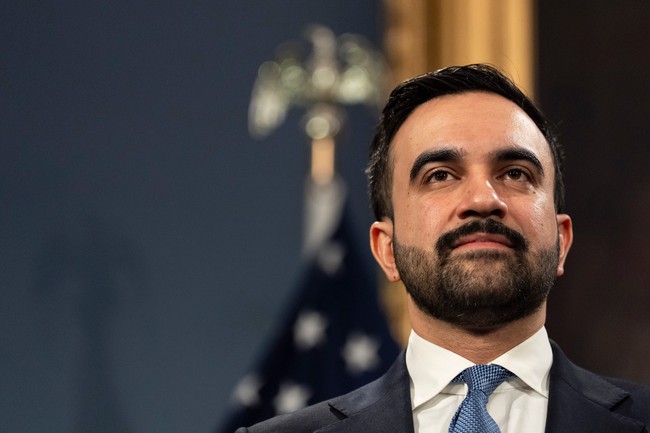
Introducing Angelo Maragos, Republican for New York City Council


I think of the RedState community as my extended family, and I’m grateful to all of you for reading my past missives on markets and finance. I’ve been all but absent from the front page for months now, and I owe you an explanation.

First, my businesses have been performing very well this year, and being a CEO is time-consuming. Second, and more interesting to most of you, is that I’ve bitten the poisoned apple of electoral politics.

My wife, Paula Hostetter, was engaged as the campaign manager to Angelo Maragos, a young businessman who embarked on the seemingly quixotic task of running as a Republican for New York City Council. I got sucked in because a political campaign needs management-type people who can build a strong team quickly, and there I was.

I’m tremendously proud of Paula, who has run a tough, disciplined campaign against the longest possible odds (more on that in a moment). We definitely broke through the clutter to reach our voters. We ran a multi-dimensional campaign that was long on organization and strategy. I can tell you that the last few years of hanging around the assorted political junkies and professionals that comprise RedState’s contributor roster, gave us insights that paid off big-time.

I’d like to say that tomorrow the voters of western Queens will decide whether we made the sale. That’s where the picture gets complicated.

Read More →


Introducing “Competition” to the Health Insurance Market


There are many good reasons to have a deep conversation about how health insurance works in this country, because there is a lot of things wrong with it. What we’re getting from Obama and Congress, however, is a PR campaign designed to distract us from the fact that they would like to change not health insurance, but practically everything about health care itself.

Reports have it that Obama’s pollsters recently suggested that the President try to make the private insurance industry the villains of the piece. This has several virtues: it’s always rhetorically good to have a single, easily-demonized bad guy; and if it works, it conveniently will distract everyone from the fact that the true objective is far deeper than simply to make insurance cheaper for those who currently have none.

(What is the true objective? By God in Heaven, I wish I knew so we could debate it openly. But the true objectives of health reform are one thing Obama and Congress are keeping a deep dark secret. I can read legalese, but I can’t predict the unintended consequences of far-reaching thousand-page laws any more than Nancy Pelosi can.)

So the rhetorical device being used against those of us who would rather know what we’re getting into, as opposed to hoping blithely that the reforms will do what Obama promises, is this: the health insurance market needs some new competition.

In a truly remarkable moment, HHS Secretary Sebelius let the cat out of the bag this morning when she said that, although a public option isn’t a strict requirement, the President is committed to some structure that will, through the miracle of competition, induce private insurance companies to “do the right thing.”

Read More →

Category:

Lanny Davis on the “Public Option”


Here’s Lanny Davis, the former Clinton team member and all-around Democratic good guy, on the subject of the “public option” crowding out private competition, and becoming a stalking horse for a single-payer system:

“I favor a public option - but the White House needs to explain better why, if public option is heavily subsidized by tax dollars, it won’t always have substantial competitive advantage over any private insurers, even those with very modest profit margins, and thus, will not result in a total federal government take-over — in effect, socialized medicine as in Canada, U.S., and the U.K.”

If I’m reading Davis correctly, he thinks there’s no problem with a public option that better communication (aka lying) can’t solve. That’s unless he honest-to-goodness believes that a public option won’t lead eventually to a single-payer system.

There’s a really stupid-simple question I have to ask. If there’s room in the market for another health-insurance vendor, then why haven’t capitalists and entrepreneurs stood up one or more new ones? By definition, that statement means that money is being left on the table. Nothing, but nothing, would prevent legitimate business people from rushing to fill that void. It’s like catnip.

Since it’s not happening, then obviously there’s no opportunity to do anything here, unless you have advantages that simply can’t be matched by the private sector.

Read More →


A Preliminary Reading of the GDP Report


This morning, the Commerce Department published the much-awaited first look at US second-quarter GDP. You’re going to hear in the news that the recession is officially over, because the economy is reported to have shrunk in Q2 at a 1.0 percent annual rate. This compares with 6.4% in the first quarter. The report also includes a large downward revision to the Q1 number, as well as downgrades to consumer spending statistics for 2008.

Exactly what does it mean to say that the economy shrank by 1.0 percent in Q2? It’s a comparison of the value of the nation’s economic output between Q1 and Q2, expressed as an annualized percentage. The economy got smaller in Q2 compared to Q1, but at a much slower rate than it had declined in Q1 from Q4 ‘08. There’s a limit to how far you can keep declining. The economy is no longer in free-fall.

Financial markets are taking this report as borderline bad news, however. The thing that jumps out of the report is that all the improvement in the economy (which is to say, the decline in the rate of decline) is due to government spending at all levels. Consumers aren’t spending more. Rather, they’re saving more.

So are we creating the conditions for a return to private-sector growth? The answer isn’t necessarily no. I think we’re creating the conditions to broadly transition the economy from a consumer-directed one to a government-directed one. The vitality and dynamism of such an economy will be far less than what Americans are used to, but that doesn’t mean we won’t have growth.

I hope you work for a defense contractor or government-funded healthcare provider, though. (Government spending on defense rose over 10% in Q2.) It’s also going to be very, very good to work for a government, since civil servants will get (and keep) gold-plated benefits, while private employees will get more uncertainty.

I’ve been saying this for five months now, in this space and elsewhere: this outcome perfectly matches the on-the-ground trends I’ve been seeing in my own businesses this year. Defense companies and health companies are spending. The bailed-out financial companies are spending. The governments are spending.

Everyone else is cutting.

Category:

The Health Insurance Industry Is On Fire


The largest publicly-owned health insurers in America are United Healthgroup, WellPoint, Cigna International, and Aetna. (Blue Cross and Blue Shield are also dominant players in this industry, but it’s harder to get financial data on them.)

A couple of important points: Health insurance isn’t the inordinately profitable industry that Obama and his surrogates say it is. By my rough count, the four big public insurers are showing aftertax profit margins of barely three percent.

And their total profits add up to well under $10 billion a year. (Again, I’m excluding the Blues.) Obama tells us that health insurance costs too much because these companies make too much money. But even if he wipes out their profits completely, he’s nowhere near the $1 trillion or more that he’ll need in order to pay for a national insurance plan.

Do you suppose the market is saying that a public-health option is a nonstarter? Look at the stocks of those four companies for this week. They’re all up strongly, as much as 20%. In three days.

Or is the market saying that if the government takes over the low end of the insurance industry, that the private companies will take the top end and become a lot more profitable than they are now? I wish I knew the answer.


Barack Obama: Worse Than Bernie Madoff?


How much would you pay for “New GM”?

About a year ago, all of GM’s common stock put together was worth maybe $2 billion, give or take, depending on the day. Go back three years, when things were merely bad instead of catastrophic for them, and people laughed at me whenever I said that GM was going to die. Back then, the stock was worth about $20 billion. For contrast, Toyota Motor at that time was worth more than $200 billion. That’s not a typo.

What would it have taken to buy GM out of bankruptcy, right now? Three years ago, when I first floated the idea to private-equity guys of my acquaintance, the answer would have been in the range of $75 billion. A few months ago, you could have done it for considerably less, depending on how far you could cram down the debt.

But now, We The Taxpayers have gotten suckered into buying the thing as a turnaround play. Barack Obama solved the debt problem by simply killing the bondholders, so he could have gotten the company for next to nothing, as opposed to the 20 to 40 billion dollars it might have cost a private syndicate. (That’s not to say, of course, that you’d ever find private investors stupid enough to do that.)

Instead, we’ve now put $50 billion in cold hard cash into this pig, with a lot more to come. And that’s to buy an asset the market has recently valued at a tiny fraction of that.

So when Obama says he’s going to sell GM back out to the public “very shortly,” what will the price be? Just to break even on his (actually, YOUR and MY) investment in 60% of the company, it’ll have to be almost $100 billion, and that’s ignoring the time value and opportunity cost. To get any kind of a decent return, it’ll have to be way more than $100 billion.

But who would pay even a little fraction of that much for “New GM,” even cleansed of its pension liabilities and long-term debt? New GM, in all candor, is an electric-car startup. I’d pay no more for New GM than I’d pay for Tesla. (And Tesla, according to the speculation which surrounded a capitalization they recently closed, is worth an absolute upper bound of $10 billion, and probably far, far less.)

Barack Obama is in the process of pulling off the biggest ream-job in financial history. Even worse than Bernie Madoff.

Category: ,

Bond Market Distress: Updated


I’ve been telling people privately to watch the bond market for about a week now. Since last Thursday, we’ve seen a very sharp, fast drop in prices for medium and long-term US Treasury securities, which (in consequence) increases yields. The yield of the 10-year note, which is a critical indicator for mortgage rates, has leapt up above 3.70%, from below 3% just a few weeks ago, and from 2% at the beginning of the year. The yield curve is now steeper than it’s been in decades.

I was wary of saying too much in public because there are indications that some of the plunge in note and bond values was due to technical market factors. The move was echoed somewhat by a fall in the dollar, but gold and oil have been relatively quiet. Corporate bonds have been on fire, with raging demand from a variety of buyers, and swap spreads are compressing rapidly.

The stock market finally got the news yesterday (falling 2%), about the same time as the mainstream press. In general, whenever you see headlines about arcane financial issues, start by assuming the opposite.

The market this morning is showing mild improvement, as it has each day this week in early trading, with yields on midcurve notes and the long bond down about five basis points or so. Yesterday was full of drama, however, as prices for mortgage-related assets (MBS and agency debt) suddenly plunged even after the Treasury completed a decently-received issue of new 5-year notes.

What is happening, in a nutshell, is that…

Read More →


Get Ready For a VAT


Ok, so the essence of Obama’s fiscal policy is to increase taxes and fees on business and on the top-earning 5% of the population. Everyone else gets tax cuts and vast increases in services, like national health insurance and enforced production of electric cars. And of course, the government has to keep stimulating the economy, because shlubs like you and I are so uncertain about the economic future that we’d rather save our money than spend it.

So what do you do when you’re the latest in a long line of Presidents to pledge fiscal responsibility while spending world-record amounts of money? You borrow the money you need to keep the string going. Obama’s first year in office will see a deficit of almost $2 trillion, about four times the biggest deficit that George W. Bush ever ran.

There are two problems with this, one minor and one serious. The minor problem is that Obama promised us a fiscally-responsible Presidency. He’s on record with a promise that when he leaves office, the Federal deficit will be no larger than 3% of GDP. (His first one will be 12% of GDP.) That’s not a problem because Obama can say whatever he wants and people will believe it. He will certainly claim that he fulfilled this promise, and be given credit for doing so, regardless of reality.

The serious problem is that no one knows what the impact will be of borrowing a trillion or more dollars every year for the forseeable future. Today, the public debt of the US is a bit more than 40% of GDP.  Sometime in the next five to ten years, it will hit 100%. Already there are signs that the bond markets are starting to find it a lot less attractive to lend money to the US Treasury.

Read More →

Category:

Obama Brings “Transparency” To Federal Budget Accounting


This one is odd, and it has a few moving parts I haven’t figured out yet, but you still need to know about it.

In case you hear the Administration start bragging about a sudden reduction in this year’s deficit by about $175 billion, here’s what they’re talking about: they’re going to reduce the amount of the TARP outlays by that much.

No, that doesn’t mean they spent less than $700 billion. (Well, actually, a bit less than $600 billion has been spent so far, but they’ll spend the rest and may need more later.)

It means they won’t add the whole amount to what they say the deficit is.

How are they going to get away with that? By accounting for the TARP outlays on a net present value basis rather than as cash outlays. Think about it like this: the stimulus/porkulus funds are different from TARP. The government either borrows or prints money, and then hands it out to state governors to spend on salaries for unionized teachers, bureaucrats, and hospital administrators, and for things like the John Murtha Airport, bike paths to nowhere, and hamster subsidies for Nancy Pelosi.

Those are pure cash outlays. From our point of view as taxpayers, it’s pure waste, money flushed down the toilet.

But the TARP funds are, and always have been, different. Approximately $17 billion of the TARP was used to buy Christmas presents and holiday bonuses for unionized employees of GM and Chrysler (that money was wasted). The rest was used mostly to buy preferred stock (and in Citigroup’s case, common stock) in something like 200 banks and non-bank financial institutions.

Read More →

Category:

Obama Grades His Budget On A Curve. Get Ready For a VAT.


Somewhat peevishly, the President went to some lengths to portray his current budget as fiscally disciplined. One supposes that he gave his people the mandate to find some impressive number of programs to cut, amounting to some impressive dollar amount. In the event, he got 121 cut programs (most of the cuts had already been announced, like the F-22 Raptor), amounting to $17 billion.

Now you know that Congress will restore most, all, or more than all, of those cuts. And you know that Obama knows that, too. So obviously, the whole exercise was intended to give him a sound bite and nothing more. But look, that matters tremendously, because from now until the end of his term in office (and beyond), Obama will say that he was the first President in goodness-knows how long to actually cut the budget.

For proof, he’ll have the news headlines: “Obama cuts $17 billion in spending; Starts making the hard choices; Down-payment on Fiscal Responsibility.” Repeating lies endlessly makes them true.

Read More →

Category: ,

Bond Market Epic Fail


Tim Geithner went to market today to sell 30-year bonds, and he got plastered. The interest rate shot up past 4.28%, and it pulled up the rest of the right side of the yield curve. The auction went unexpectedly bad as there were relatively fewer bids than in the past.

Before you rush to say it, no, the Chinese weren’t in there buying. But that part is NOT a surprise, because foreigners and central banks generally stick to buying short-dated securities. China stopped buying our long bonds back in 2007.

One of my colleagues reminded me that Britain and Germany had serious failures to sell debt earlier this year. The US Treasury borrows in its own currency, so they have nothing like the constraints that the Germans or the Brits do. At least in theory, the Treasury could borrow at any interest rate necessary to clear the market, because they can print money to pay the interest.

The problem is that if the risk-free rate is extremely high in any particular stretch of the yield curve, it necessarily raises the corresponding interest rates for actual business borrowing, possibly to the point of choking off actual business investment.

But it’s funny, because this whole conversation is the kind you’d have in normal times. These aren’t normal times. Bank credit is exceptionally scarce at any price, for more than one reason. Geithner is already using coded language that suggests to me that he finds this ultimately acceptable, so long as government entities can create credit themselves.

And at the end of the day, it truly is frictionless for the government to create credit. But the problem is that there will be very few organic market signals for allocating it, which is a fancy way of saying that the economy won’t be producing things people actually want to buy.

If nothing changes, then ten years from now, Americans will be telling each other Euro-style things like “I work to live, man, I don’t live to work,” and “as long as I have what I need and my retirement is guaranteed, I don’t really need anything more.”

And Obama will get credit for making America a kinder, gentler place. It’ll be really boring, though.


Chrysler


This is a very quick initial response to the extraordinary announcement of the Chrysler LLC bankruptcy filing. We don’t have all the answers, but that’s partly because we don’t even have all the questions. Something very new and different is happening here.

It’s very far from clear to me that this is a Chapter 11 bankruptcy in any normal sense. For one thing, why is it being announced by the President of the United States rather than by Bob Nardelli?

In reading the news reports, there’s a tremendous number of moving parts here, and no one is being very clear about it. I have at least two very big questions, one of which is public and the other isn’t.

The public question relates to Fiat. Marchionne has been very emphatic that he will put no cash into Chrysler in return for Fiat’s stake, which starts at 20% and could go as high as 51% by 2016. Fiat is giving nothing but access to small-car technology. That can only mean that the government intends to dictate Chrysler’s production mix. That in turn means that the government has chosen to enter the auto business in a forthright and unprecedented way.

The private question relates to the current owner of Chrysler, which is Cerberus Capital Management, one of the most powerful, most wealthy, and most feared private equity groups in the world. They easily have access to billions of dollars they could invest in Chrysler. The fact that they simply don’t want to, tells you that this company isn’t worth investing in, and ipso facto the taxpayers are flushing money down the toilet.

But I want to know much more than that. I want to know exactly what consideration will be paid to Cerberus in return for the common stock that will be ceded to Fiat, to the government, and to the UAW. Are we bailing out a bunch of politically-connected billionaires?

And you can’t say you haven’t noticed how effectively they’ve kept their name out of the news. Whenever you get a chance, ask anyone who will listen: WHY HAS OBAMA NOT TOLD US WHAT HE INTENDS TO GIVE CERBERUS IN RETURN FOR CHRYSLER?

Read More →


New York City Is Barack Obama’s Town. We Just Live In It.


This isn’t going to be a major story, but I’m awfully sore about it, and I’m not the only one.

Shortly before 10am this morning, a low-flying airliner buzzed New York Harbor just south of Manhattan, tailed by a pair of fighter jets. In case you weren’t here one dazzling September morning eight years ago, that’s exactly the flight path taken by the airplane that hit the south tower of the World Trade Center.

So what do you do when you hear that sickeningly familiar sound? Of course: you go into near-panic and evacuate all the office towers. That’s pretty close to what we did.

Now, we’ve come to find out what it was all about. If you haven’t heard this story, please brace yourself.

It was one of Barack Obama’s planes. It was one of the 747s used as Air Force One. They flew it past the Statue of Liberty. To snap some publicity pictures.

Why are we hopping mad about this? Because no one bothered to tell us. Apparently, DHS informed the New York police, but then instructed them not to say anything about it. The only thing I can guess is that they were afraid one of our friendly neighborhood terrorists might take the opportunity to fling a shoulder-launched missile at the thing.

So people I talked to (who were there on 9/11) said they heard two really loud flybys, and ducked because the next sound they expected to hear was a big crash. If you’re not from here, it’s hard to explain how sensitive people still are about this.

Why on earth did our President do this to us? Was he just plain thoughtless? Or was the insensitivity willful?

Category:

Frakking Fast Cars


Your RedState front-page contributors have a lively back-channel communications system, in which we plot and plan strategy and discuss the critical issues of the day. (And yes, we talk about you too, Dear Readers.)

One of my colleagues just expressed the meaning of his life thusly:

“I absolutely LIVE to drive fast.  I work and advance my career so that I can have frakking fast cars.  That pesky little house and other possessions are there merely to facilitate my car habit.”

This statement was remarkable to me, given that I’m a New Yorker (say what you want about that, I’ve heard it all), and more to the point, that I’m not a licensed driver. When I need to go somewhere in a car, I pay someone else to drive me.

But I believe that my friend and colleague’s views on the matter of driving are a lot closer to normal than mine are. And that got me thinking about some important aspects of Obama’s economic blueprint for America.

Read More →

Category:

About Freddie Mac


You’ve seen the reports that Freddie Mac’s CFO was found dead at home this morning, an apparent suicide. One unstable newbie CFO doesn’t bother me too much, and the event isn’t causing much of a ripple in the bond markets this morning.

The interesting thing about Fannie Mae and Freddie Mac is that, quite below the radar, they’ve morphed into practically full-faith-and-credit debt issuers. The term sheet under which they were nationalized last September provided that they should divest about one-tenth of their portfolios each quarter, with proceeds to benefit the Treasury, putting them on a glide path to full dissolution in three years or so. Instead their role has only gotten bigger and more systemic.

It’s no exaggeration to say that most new issuance of mortgages in the US (including refis) goes through Fannie and Freddie. But these mortgages are ultimately being funded by people who think they’re buying Treasury paper with a slight yield kicker, not by people who actually want exposure to US mortgages. If the market were to find its own level without this implicit federal support, it would be shockingly lower than it is now.

This is bad for at least two reasons: first, it misallocates economic resources, by definition. We simply have no way to know what desirable and healthy things the economy would be doing with the resources being forcibly directed into keeping housing overpriced.

And second, how do we ever remove the Federal support? No Administration will ever be willing to find out just how low housing values can really go. US housing has been permanently socialized.

To my readers here at RedState: I apologize for my low blogging output in recent weeks. As many of you know, I’m a CEO, and sometimes business gets very busy. I’m happy to say that conditions have been getting noticeably better, at least in the markets I participate in. Once things settle down a bit, I’ll be blogging more again, here and elsewhere.


Obama, Channelling Orwell, Comes Clean on His Intentions for GM


“We cannot continue to excuse poor decisions” and “cannot make the survival of our auto industry dependent on an unending flow of taxpayer dollars.”

Thus Barack Obama, on the subject of General Motors. This was in the course of a speech given yesterday, which indeed rewarded poor decisions by giving the company 60 more days to keep operating on taxpayer life-support.

Obama is the Revolution of Circumlocution. Whenever you want to know what he actually means, just reverse his statements 180 degrees.


Lipstick on a Pig


The President of the United States is a man who has succeeded largely by substituting charisma for substance. It’s critically important for him to look like a heavyweight. Understanding this well, the New York Times is obliging Mr. Obama with the headline “Obama Issues Ultimatum to Carmakers,” accompanied by a picture of the Great Man looking stern and powerful by contrast with the non-entities who appear alongside him.

Under the terms of the deal in which GM borrowed emergency funds from the government last December, the company is required to produce a credible operating plan with sharp cost-cutting measures by March 31, or else face a demand to immediately return the funds (thus triggering immediate moves by creditors to liquidate GM). Those of us with eyes knew at the time just how empty a covenant this would turn out to be.

Today, Obama is putting lipstick on the pig. He’s presenting what is called an ultimatum to GM and Chrysler (the beneficiaries of emergency government funds), to shape up or ship out. And they have 60 days to do it. We don’t really know what Obama actually wants to see happen in 60 days. Characteristically, he doesn’t say, which is your cue to add your own writing to his blank slate.

Why am I so cynical? Because the deal was for GM to restructure or die by March 31. Obama just gave them a sloppy wet kiss in the form of a 60-day reprieve, and he wants us to think he was being tough. The only cost that he imposed on GM was the dismissal of CEO Wagoner, whose departure has long been only a matter of time. And I’m betting that 60 days from now, there will be another big dollop of taxpayer funding for GM, accompanied by more harsh words.

And of course, another opportunity to take stern photographs of our Dear Leader.


General Motors Hurtles Toward Bankruptcy


The big headline yesterday was that GM CEO Rick Wagoner is being dismissed in favor of Fritz Henderson. This isn’t remarkable in itself, because no one expected him to last, despite having the oft-expressed (in public, anyway) full confidence of GM’s board .

Today, the President of the United States is expected to make significant announcements about GM’s warranty policy. No, that’s not a typo, and yes, it’s remarkable. I didn’t say the President of General Motors, I said of the United States.

Since when does an urban agitator and small-time legislator with a law degree think he can run an enterprise with 100,000 employees, thousands of vendors, millions of customers, and operations in every part of the world? Well, that’s one of those questions you’ll just have to ask the people who voted for him last November. I can shed some light on the rest of this.

And there’s another really remarkable aspect here, which speaks either to tremendous political skill or luck among the Democrats: they kept the whole thing out of the news for the last three months.

Read More →


Congress Prepares to Create Some New Unintended Consequences


In the late 1960s, there was a well-publicized furor over corporations and individuals with very high incomes who, through combinations of legal tax-avoidance activities, wound up not  paying income taxes. So Congress responded with the Alternative Minimum Tax (AMT), which now hits millions of individuals and can’t easily be adjusted because it brings in too much revenue.

I’m now hearing stories about employees of Wells Fargo (which took TARP money not by choice but by force) who make $250K (which in my part of the country barely qualifies as middle-class) in total household income. These people will see their year-end bonuses taken away, if the bonus-clawback bill passed by a large bipartisan majority in the House becomes law. We’re not talking about a few hundred traders and executives at AIG anymore.

So, intentionally or not, has the House just created an income cap at $250K that eventually will get spread far and wide throughout the economy? After all, it’s obviously unfair to apply a salary cap only to people who just happen to work for a company that was forced to take TARP money against its will. So the only response would be to abrogate the salary cap altogether (making Congress look even stupider than they look now), or to spread it to many more companies.

Will the Senate be smart enough to see this for what it is when it’s their turn to vote on it?

Category: ,

A Few Important Clarifications About AIG


We’ve been watching the President of the United States hyperventilate in shock over the fact that publicly-owned financial companies pay bonuses even when they lose money. It’s really hard not to get the impression that Obama is playing to the galleries here. He and David Axelrod were probably blindsided by the public furor that this news kicked up, even though the Administration was well aware that the bonuses would be paid, so they decided to jump in front of the parade.

Let’s leave aside the critically important question of whether the government should force AIG to break the contracts it freely made with its employees, and acknowledge that the public wants a pound of flesh. Even though there is a principled case to be made in favor of the bonuses, principle is something Obama has never known or cared anything about.

It makes more sense, rather, that he decided he’d better turn AIG into the bete noir, or else he’d see the people’s righteous anger turned on himself, heaven forfend. As always with this President, politics trumps policy.

But I need to clarify an important point that is getting thrown around by a lot of people this morning: the idea that a lot of the money that taxpayers gave AIG was actually paid out by AIG to other, perfectly healthy banks and investment firms, and also to some banks that themselves received government assistance.

Perfectly true, and perfectly misleading.

Read More →

Category: ,