« BACK  |  PRINT

RS

MEMBER DIARY

Democrats & the Blue Green Alliance: Union Flunkies Flunking History.

Insanity: doing the same thing over and over again and expecting different results.

There is a question that has been debated in some circles for a while now: Are the union-controlled Democrats purposely trying to drive the nation into another Great Depression, or are they just that ignorant?

The problem is, no matter how you answer that question (ignorance or malice), both are dangerous for the country.  In the spirit of optimism in humanity, one probably could believe that it is ignorance (that, and a strange crush on John Maynard Keynes).  However, given the Marxist March on Washington this past weekend, it’s really tough to think that there isn’t some nefarious scheme being passed around from Nancy Pelosi’s PDA to the President’s teleprompter.  To further add to those nagging suspicions is the fact that all Democrats need to do is open a history book and watch how they’re making the same mistakes (intentional or not) that the political leaders of the 1930s made.

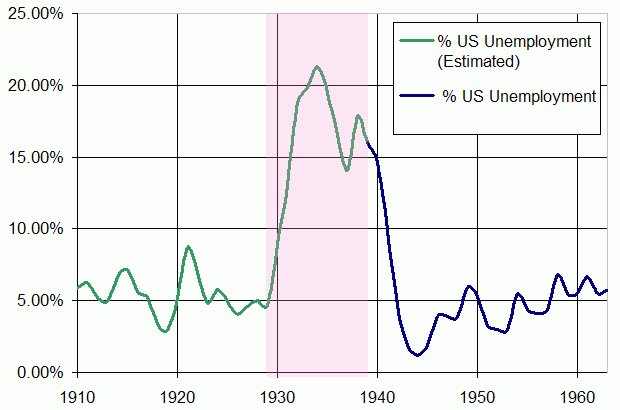
Repeating the Past. A decade of low employment and “irrational exuberance” was followed by a tanking of the stock market. Then, a well-spoken president comes in (no teleprompters in those days), greatly expanding government power, spending wildly, enacting new entitlements, demonizing business, levying heavy taxes, as well as cozying up to union bosses. And, despite all of those government-spending programs, unemployment remains extraordinarily high.

Does this sound eerily familiar?   Indeed it should, because 70 years later Democrats are making many of the same mistakes that were made during the Great Depression—and it may be about to get a whole lot worse.

Are Democrats About to Make High Unemployment Higher?

We’ve opined in the past about how businesses are averse to risk. Now, even the New York Post, in an oped by Sen. James Inhofe (R-OK), is labeling the Obama administration’s regulatory uncertainty Obama’s ‘quietest job-killing machine.’

One insidious force keeping unemployment high is regulatory uncertainty: Companies that could hire (or re-hire), don’t — because they’re worried about what new restrictions will be coming down from Washington.

Congress bears much of the blame — especially for the new “financial reform” law, which leaves so many details to be filled in later. But a major contributor to businesses’ worries is the Obama Environmental Protection Agency, which is issuing a daily barrage of rules and regulations threatening jobs in American industry.

The Politics of Protectionism. The real ghost from decades past that Democrats seem to be resurrecting is the Smoot-Hawley Tariffs.  The Smoot-Hawley Tariffs (signed into law in 1930 by President Hoover) were based on the misguided belief that, if America restricted trade, it would somehow translate into more jobs.

In short, the Smoot-Hawley Tariffs failed.  Miserably. Not only did they fail, the Smoot-Hawley Tariffs made a bad situation worse as employment went into a freefall, soup and bread lines formed, and a depression became the Great Depression.

It provoked a storm of foreign retaliatory measures and came to stand as a symbol of the “beggar-thy-neighbor” policies (policies designed to improve one’s own lot at the expense of that of others) of the 1930s. Such policies contributed to a drastic decline in international trade. For example, U.S. imports from Europe declined from a 1929 high of $1,334 million to just $390 million in 1932, while U.S. exports to Europe fell from $2,341 million in 1929 to $784 million in 1932. Overall, world trade declined by some 66% between 1929 and 1934. More generally, Smoot-Hawley did nothing to foster trust and cooperation among nations in either the political or economic realm during a perilous era in international relations.
Smoot-Hawley Redux. Ironically, the Smoot-Hawley Tarrifs were passed and signed into law by Republicans—and, now, it is the Democrats who are falling into the same ill-conceived trap.  In fact, the Tariff Act of 1930 (Smoot-Hawley’s official name) is still on the books.  Now, though union-backed Democrats are dusting off the rusty idea of protectionist tariffs and, at the heart of the new eco-union empire, is the United Steelworkers.

The Steelworkers, which is formally known as the United Steel, Paper and Forestry, Rubber, Manufacturing, Energy, Allied Industrial and Service Workers International Union, with around 700,000 members, is the largest manufacturing union in North America today.  After decades of unions helping to open the door to foreign competition by devastating strikes like the 1959 Great Steel Strike, America’s manufacturing unions have watched their base erode and, as a result, have been faced with an either-or: Either merge with other dying unions or die. For those unions that sought to survive, the United Steelworkers became the ‘melting pot’ for dying unions to jump into.

Strange Bedfellows. In 2006, something strange happened.  Planets shifted, oil mixed with water and, after years of fighting environmental regulations that all-too-often killed union jobs, the United Steelworkers joined the Sierra Club to form the Blue-Green Alliance.  Since the BGA’s founding, more of the ‘usual suspects’ have jumped into the Blue-Green Alliance:

Launched in 2006 by the United Steelworkers and the Sierra Club, this unique labor-environmental collaboration has grown to include the Communications Workers of America (CWA), Natural Resources Defense Council (NRDC), Service Employees International Union (SEIU), National Wildlife Federation (NWF), Laborers’ International Union of North America (LIUNA), Union of Concerned Scientists (UCS), Utility Workers Union of America (UWUA), American Federation of Teachers (AFT), Amalgamated Transit Union (ATU), Sheet Metal Workers’ International Association and the United Auto Workers.

[Heh. If one didn't know any better, one could assume the BGA is one of those 'shadowy groups with harmless-sounding names' the president often likes refers to.]

The BGA’s seemingly benign goals listed on its website are as follows:

  • Pass comprehensive clean energy and climate change legislation that is based on two overriding principles – the best scientific advice on reduction targets and solutions that create and save millions of American jobs;
  • Restore the rights of workers in the United States to organize and bargain collectively;
  • Establish a 21st Century trade policy that promotes growth and prosperity across all sectors of global society, and embeds enforceable labor, environmental, and human rights standards in our trade agreements; and
  • Create an informed 21st century policy on toxic chemicals that protects workers and communities from dangerous chemicals, enhances public health and promotes safer alternatives.

The Blue-Green Alliance is the organization that has been backing the White House’s push toward ‘green jobs’ that will, of course, be unionized.  The effects of the Blue-Green Alliance are already being felt in “eco-friendly” (but unaffordable) alternatives for consumers:

People who are interested in choosing fencing that uses sustainable materials have options, but most of them will cost more than traditional vinyl or wood fencing.

Pricing has prevented green fencing from becoming a major part of the market for many area companies and major home improvement stores like Home Depot and Lowe’s, according to those in the field.

[snip]

Murphy said her company does offer composite wood fencing, which uses a combination of vinyl, sawdust and recycled wood. But she said she only gets a few customers a year asking for that product.

Composite fencing can cost twice as much as vinyl fencing, which can run up to $130 per panel. A wood fence is still the cheapest option at about $50 per panel, she said.

The costliness of the ‘eco-friendly’ green economy (not to mention the lack of credibility of people like Al Gore) is causing consumers to shun the ‘sustainable stuff’ campaign—especially in the middle of a deep recession—and continue buying goods that are less expensive…even if they’re made overseas.

This makes people like Leo Gerard, the president of the Steelworkers union mad.  You see, after taking his union to the green side, he’s perturbed that his members are still losing jobs because consumers are choosing, just as steel consumers did after the 1959 steel strike, cheaper alternatives to the eco-union alliance. So, as a result, to try to help speed things up, Gerard and his comrades have fallen back on the age-old protection of the government.

In 2009, the Steelworkers (and other unions) convinced their Democrat puppets in Congress to insert “buy American” language into the $787 billion, which immediately sparked outrage with the U.S. neighbors to the North.

This week, the Canadians fired back. A number of Ontario towns, with a collective population of nearly 500,000, retaliated with measures effectively barring U.S. companies from their municipal contracts — the first shot in a larger campaign that could shut U.S. companies out of billions of dollars worth of Canadian projects.

In September 2009, the Steelworkers once again order the Obama administration to impose trade penalties on China’s tires. Once again, Obama complied, sparking a sharp rebuke from China:

Chen Deming, China’s minister of commerce, said the penalties would hurt relations with the U.S. A ministry statement said Obama had “compromised to the political pressure of the U.S. domestic trade protectionism.”

“The Chinese government will continue to uphold the legitimate interests of China’s domestic industry and has the right to take corresponding measures,” Deming said.

Later in September (2009), the Steelworkers and three of the paper companies that employ USW members joined forces to instruct the White House to take on Asia over paper prices:

A trade tiff over tires may escalate into a full-fledged trade war, with American unions taking on Asian exporters.

Three American paper companies, joined by the union that represents their workers, charged on Wednesday that unfair trade practices in China and Indonesia have cost thousands of Americans their jobs by driving down the cost of paper.

Now, as the Steelworkers and the handful of unionized companies have campaigned for increasing tariffs, they have gone a step further by dragging their environmentalist allies into the fight, creating what the Consumers Alliance for Global Prosperity calls Empires of Collusion.

null

It gets worse. Last week, the House of Representatives, before heading home to campaign for the mid-term elections, took the first step in what may become a full-fledged trade war with Asia by passing HR2378, otherwise known as the Currency Reform for Fair Trade Act.

While generally worded, it is largely aimed at trying to curb China’s alleged currency manipulation—something that has plagued the U.S. for at least two administrations—the “do good” desires of the union-fronted Democrats (with bi-partisan backing in the House) may result in an economic disaster if history repeats itself.

While the bill still has to clear the Senate, the Wall Street Journal noted on Monday:

The bill, if passed by the Senate and signed by the president, would mandate that the Department of Commerce take a foreign country’s currency interventions into account in determining whether its trading practices are unfair. In the case of China—the target at which this bill is aimed—Commerce would determine that the amount by which the yuan is allegedly undervalued. The number being thrown around now by supporters of the bill, such as the AFL-CIO and the United Auto Workers, is as much as 40%. The cost basis of Chinese-made goods exported to the U.S. would then be adjusted upward by that amount to determine whether they are being sold below cost, an unfair trade practice known as “dumping.” Not a single Chinese export good could survive such a test—virtually the entire volume of China’s exports to the U.S. suddenly would become subject to countervailing duties.

Surely China would retaliate. That makes the bill a nuclear threat of mutual assured economic destruction. If carried out, it would crush trade between China and the United States, which are huge export markets for each other.

Given the already-fragile economy in the U.S., this nation’s debt to China, as well as China’s relative economic stability, it seems that a union-backed trade war is not something that should be entered into with all eyes wide open as it could easily lead to a full-scale depression, at least here in the U.S. and, likely, elsewhere.

This then, begs the question asked at the beginning:  Are the union-controlled Democrats purposely trying to drive the nation into another depression, or are they just that ignorant?

Insanity: doing the same thing over and over again and expecting different results.
—Albert Einstein

On November 2nd, take a step at stopping the insanity: Vote.

__________________

“I bring reason to your ears, and, in language as plain as ABC, hold up truth to your eyes.”  Thomas Paine, December 23, 1776

Cross-posted on LaborUnionReport.com

For more news and views on today’s unions, go to LaborUnionReport.com.

Follow laborunionrpt on Twitter

COMMENTS

  • http://charlemagne-the-hammer.blogspot.com/ DerKrieger

    Given that most of the bosses of the big unions are outright Marxists who have dreams of a US workers paradise I believe this is intentional. It’s ignorance on the part of the average working stiff though. They’re just useful idiots to the Commies in charge.

  • raginpatriot

    Find some anti-American billionaires (Soros, Peter Lewis, etc.) who will fund the not-so-hostile takeover of the Democrat Party, in order to provide a front, a chimera of legitimacy to their radical aims (see David Horowitz’s book “The Shadow Party”);

    Take one charismatic anti-colonialist (as posited by Dinesh D’Sousa in his new book) and who’s adult life has been steeped in associations with Marxists and radicals of various stripes (Frank Marshall Davis; Bill Ayers; Reverend Wright to name but a few), and who can in the tradition of the great fascists inspire the masses / turn them into useful idiots via soaring but vague rhetoric, so that upon his personage they can project their hopes and dreams … even as he intends to “cut America down to size”;

    Execute with a variation of the Cloward-Piven strategy, albeit not exclusively deployed via the welfare / social services system, but (leveraging the expertise of the aforementioned billionaires) on a macro-economic basis, intending to bring down the U.S. with a “death of a thousand cuts” of expanding entitlements and control over individual Americans (Obamacare); over the economy in general (“financial reform” and “cap and trade”); bypass Congress (czars and the aforementioned legislation that shifts power to the executive regulatory state and federal reserve); massive debt used to fund a dependency class / reliable party base (public sector unions) while simultaneously incurring such debt as to make the U.S. subject to the influence of its creditor nations and / or result in debasing the currency.

    As it is being executed, borrow a page from FDR’s playbook and as he did, blame it all on his Republican predecessor, in this case George W. Bush instead of Herbert Hoover.

  • n6532l

    The author(s) of this piece funk not only history but economics, politics and current events to boot.

    It was not in the least ironic that Republicans passed Smoot-Hawley. Every Republican Presidential candidate from Abraham Lincoln in 1860 to Alf Landon in 1936 ran on a platform endorsing high protective tariffs. Theodore Roosevelt wrote: “Thank God I am not a free-trader.

    • http://impudent.edublogs.org/ kyle8

      We have developed a zeitgeist in economic circles that worships at an altar of free trade. But the truth is that America had it’s greatest growth under very high tariffs. As did Japan, and as has China.

      Nevertheless, I don’t think that protectionism is necessarily a good thing. The modern world is characterized now by enormous amounts of trade between nearly every nation. And that has had the direct effect, (since the modern low tariff era began in the 1980′s) a tremendous growth in the wealth of the world overall. Dozens of once poor nations have moved up to wealthy or near wealthy status.

      The problem, as I see it, is that because of the success of international trade. The politicians in this country have allowed our trading partners to walk all over us. And I am not just referring to China and it’s many trade barriers and currency manipulation. The EU also has created a myriad of “safety, and ecological” barriers to US products.

      The other problem with protectionism is that it would not be done correctly by modern politicians. The only way to make it work is to use the taxes collected by trade barriers as a way to fund government, and subsequently slash other taxes so that domestic businesses could prosper. That is necessary because other nations will retaliate and our companies will have to pay more for tools, raw materials etc.

      I don’t think it can be done and will only cause hardship. However, I do wish our leaders would use some existing trade law to come down harder on cheating trade partners.

      • acat

        Government income is up some – due to tariffs – so direct taxes on individuals can be lower; coupled with import prices are higher, so domestic competition can make higher profits (and pay higher wages) so domestic companies grow quite nicely.

        The counterpoint is that there’s more growth worldwide with low tariffs, it’s much more spread out.. worldwide .. so domestic companies do not grow as well.

        At this point, given the state of the economy, it may be a Good Idea to look at higher tariffs on some items that have little or no domestic industry. Don’t use tariffs to protect an existing industry, use it to spur growth in a new (to us) one.

        Mew

        p.s. And, of course, enforce enforce enforce! If we can check every shipping container for hazardous cargo, we ought to be able to figure out what the tariff is for each one as well… also, the enforcers will have jobs… maybe we can get some of the really bad apples from the TSA to transfer…

        • aesthete

          I cannot think of a single sweeping policy change that a free-market economy could make that would be more destructive in our recession than high tariffs or the resurrection of “industrial policy”. Your thought process has been used in may African countries under anti-colonialist and atuarkial grounds in many countries in Africa and Latin America, and the effect has been to raise prices in the general economy for all participants, and to retard growth and efficiency in the given industry by insulating it from competition. Rent-seekers sure like it, though. The Great Depression was, historically, a time when tariffs were high around the world. This was extremely damaging, and did not help employment, economic growth, or any of the other factors that are typically mentioned by anti-free traders. I’m absolutely a “worshipper” at the altar of free trade, for the same reason that I “worship” the free market: in both cases, the mutually advantageous arrangements that result tremendously increase the living conditions and aggregate GDPs of both countries, especially long-term. Tariffs have never spurred growth or economic well-being: it is foolish to think that restricting voluntary trade will mean that both parties will be better off!

          • acat

            Besides, I specified “higher”, not “high”, meaning “increased from the current low”, not “extreme”.

            I am a pragmatist, believing that strategically, if we want certain industry to remain in North America despite competition today (steel, for instance, or perhaps high-tech) then we need to put up enough of a barrier – not a “high” barrier, but enough of one – to balance the cost so the domestics have similar footing. Higher cost of living per employee here than in, say, China.

            That does not mean I’m opposed to trade – it means I’m looking at a picture in which trade is one way nations may interact – and war is another – and we give up the ability to beat our plowshares into swords at our peril.

            We’re not nearly so far apart as a serious worshipper of protectionism would be from you ..

            Mew

          • aesthete

            on which, as is the case with minimum wage and rent control, the proof against tariffs and industrial policy is so overwhelming as to be incontrovertible. Even liberal economists like Paul Krugman have show this to be the case: his Nobel prize-winning work is the last in a long and proud body of economic work showing that there are few, if any, gains to be made by using tariffs to promote “industrial policy” or any other economic goal. (This is without accounting for second-order conditions related to increasing tariffs, such as the possibility for a trade war, frostier foreign policy relations, etc.) I’m personally not for any sort of “national” economic policy beyond providing for the common defense, but if you want to be “pragmatic” and promote the industries noted, there are several, much more efficient ways to do so (subsidies, targeted tax cuts, consistent and pro-business copyright and regulatory structure, etc) than through tariffs, which are almost always destructive (think back to all those “energy independence” rubes on the left who talk about tariffs for imported oil).

          • acat

            The guy may be brilliant, but it appears uneven, in an idiot-savant way. A self-described liberal and Keynesian, he opposed the Bush tax cuts, and blamed the 2008 meltdown on Gramm and Greenspan, instead of more accurately on Carter and Clinton and Frank. While he seems to have figured out the South-East Asia problem faster and more correctly than Turbo Tax Timmy did (at the time Turbo was over at the IMF) that’s hardly a high bar to clear.

            I do think you need to better understand what Krugman is saying, by the way – his NTT theory has no problem with using a tariff to protect a “strategic industry”, in fact it appears to make such a tactic very sensible indeed, but Krugman himself states that identifying such an industry is the devilish point, and the point that most countries trying to create industrial policies fail at.

            My point, which you’ve glossed over, is that there are some industries that can be identified as critical to maintaining national sovereignty – related to feeding and arming the population, guns and butter in the old parlance – that should be protected to a point.

            You appear to be arguing that it’s not a problem to import all our steel from China – I’m saying it is a problem to not have a domestic steel mill industry as we appear to be on a course that will eventually conflict with China, and retaining the ability to produce our own raw steel would be less expensive than needing a crash program to rebuild should the Chinese decide to cut off trade…

            Mew

          • http://impudent.edublogs.org/ kyle8

            “Tariffs have never spurred growth or economic well-being:”

            As I stated before most of the worlds biggest industrial economies had their greatest growth during periods of high tariffs. That is simply a historical fact.

            Now, I know that other factors are involved, And As I stated before I am not in favor of high tariffs for a mature economy like ours. But it is simply a myth to say that they are always harmful.

            If I were advising a growing, immature industrial economy I would indeed reccomend protective tariffs if they had a large enough consumer base to help grow those industries.

          • aesthete

            Most of the countries you are thinking of (US, UK, Germany) became industrial economies at a time when other countries had even higher tariffs, so that those countries were even more restrictive of trade. In the case of the US and the UK, in particular, their respective strong laws protecting property and copyrights, innovation on the part of the citizenry, shared culture of the citizenry, and geographic benefits make it unlikely that their success was due in any part to tariffs (in fact, I wonder if free trade couldn’t have made their growth as industrial powers that much more successful). Most of the nascent American industries protected were already going to be developed (ditto Germany and the UK), and in the US and the UK (not too sure about Germany, but I suspect it was the same), tariffs were enormously subject to rent-seeking, rather than implemented in an efficient manner. At any rate, pointing out the clutch of industrial powers which followed Smith and Ricardo most faithfully as positive examples of protectionism is a bit of a poor argument for them, IMO. (Especially when you consider that the US is an area about the size of Europe, and that the states therein are essentially bound together in a free trade agreement.)

            Certainly, there is little evidence to suggest that tariffs are in any way optimal or efficient relative to free trade: even the darling of protectionists, Japan, had protectionist policies which had little to with the aspects of the auto industry that ultimately succeeded. The second-order effects, as well as problems with pushing infant industries out of the infancy stage make protectionist policies even poorer in effectiveness than straight economic analysis would indicate.

          • aesthete

            of import-substitution industrialization (the closest that thought got to being rigorously applied) in Latin America, the only region to attempt it without significant interference. You are right that larger countries with large domestic consumer bases have a better go at it than smaller ones (see Brazil and Mexico), but the distortion of incentives, maintainment of inefficient industries, and rampant rent-seeking that characterize these economic strategies tend to lead to more anemic results that would have been avoided had free trade strangled the more inefficient indistries in their cribs.

          • JSobieski

            If you look at the richest 10 countries on a per capita basis, small countries dominate.

            http://en.wikipedia.org/wiki/List_of_countries_by_GDP_(PPP)_per_capita

            Plausible explanations:

            No temptation for protectionism
            Big government easier to avoid
            Clear need to compete internationally/no illusions of just sitting back

            I should point out that Hong Kong has no natural resources to speak of, had the lowest trade barriers in the post WWII era and became one of the wealthiest locations on the planet.

            Some countries did become prosperous while utilizing trade barriers, but I don’t think trade barriers were the cause of the prosperity. Otherwise how do you explain Hong Kong?

          • aesthete

            Which was essentially formed as a nation because it wanted free trade and had to kick the Spanish out to get it (well, that’s reductionist, but it was a motivator).

          • JSobieski

            You penalize the population at large for the benefit of a politically connected subset. Sounds like the mirror image of unions in the 21st century.

            “Pragmatic trade policiies” is just another way of justifying socialized medicine since foreign corporations don’t provide health benefits.

            Its also worth pointing out that trade was a de minimis portion of GDP back in Lincoln’s day Moreover, the cost and reliability of transporting goods across the Atlantic ocean in a timely manner made trade policy largely insignificant in the 1800s.

            There are good reasons to conclude that protectionists policies are not responsible for US prosperity in any period of time..

          • http://impudent.edublogs.org/ kyle8

            And I have heard them all before. Overall I would be inclined to say that you are right, Free trade is better in almost every case. I just am not convinced, and I don’t think the evidence is there, to say In every case.

            There are very few absolutes in the world. Even in our struggles with the left wing. It would be entirely incorrect to say that nothing good ever came form the left, or that conservatives have always been right.

            My main concern is the emergence of dogma in economics. Dogma is not a good thing, it is destructive, it causes you to stop thinking.

            One of my main problems, on a different subject is that I see a dogma emerging in economics about anti-anti-trust. To the point now where some economists are rewriting history and saying that no anti-trust was ever needed or good. I find that worrisome.

          • JSobieski

            Supply and demand at a micro level isn’t so far removed from say the laws of Newtonian mechanics.

            I can be dogmatically in free trade while still acknowledging that lefties weren’t wrong about everything. I think the “always right” argument is a straw man.

            Is it dogmatic to say for example, that increasing taxes on a particular behavior will directionly act to impede that behavior and the increasing the subsidies for a behavior will incrementally increase that behavior?

            I don’t think those statements are controversial, kind of like saying that F = ma

          • JSobieski

            apply only to the economic sphere.

            There may be military, human rights, social, and other reasons to enact rules that are not economically maximizing. However, we shouldn’t lie to ourselves and justify such policies on economic grounds.

            I am all for keeping the Chinese away from missile guidance systems, but I wouldn’t justify the restriction on economic grounds.

            If you are going to just protectionism, it should be done on social grounds (displacement of American workers) not economic grounds (it would hurt the overall economy).

            In terms of anti-trust, the doctrines haven’t changed that much in the past 20 years. Its just harder to get 70% of a market in an era of global competition and technological substitutes.

            With the exception of heavily regulated industries, what companies to you think can actually exercise monopoly power?

          • acat

            That is, that economics does not exist in a vacuum – there are other considerations a nation needs to bear in mind to remain viable – trade is just one factor.

            Taiwan is a very good example here – without rather strong support from other nations including Japan, south Korea, the U.S., the Aussies – Taiwan would have been forcibly re-absorbed into China some time ago. They balanced themselves between these non-economic (but surely national) interests and managed to make a buck doing it. Not bad for a poor province with no national resources.

            I have no objection to free trade in principle – but in pragmatic terms, there needs to be a balance between free trade and national interests…

            Mew

          • aesthete

            is that “national interests” or “social benefits” tend to be broadly (and poorly) defined, and that there are certain foreign policy interests that are actually furthered by free trade (and damaged by protectionism), such as a better chance at forging enduring, positive relations through trade, more efficient (even if smaller) domestic industry due to competition, and a general lack of the problems inherent in rent-seeking.

            Is it a good idea to import all of our weaponry or to contract out our military logistics, satellite, and communications networks out to foreigners? Probably not, but there’s a long chasm between that and “protecting” domestic industries that are doing well on their own (high-tech, agriculture, industry, etc) and which would perform inefficiently if insulated from the rigors of global competition.

          • JSobieski

            meaning that most protectionists dislike free trade because they erroneously presume that trade barriers will result in more jobs in the US, and a higher standard of living here for everyone.

            Trade barriers for say national security purposes is almost never referred to as protectionism, its referred to as export regulations. Reagan was an avid free trader, but he didn’t support selling advanced missile technology to the Chinese.

            I think the term “free trader” is being misused by people arguing against it. I am not aware of any free trader (including radical libertarians) who want unbridled ability to sell nuclear devices to rogue states or rich individuals.

            Who is out there arguing for free trade outside of an economic context? What I see is protectionists justifying trade barriers using any way they can see fit to do so, while mischaracterizing free traders as selling hi tech ropes to the Chinese.

            Lots of straw is being hit in this thread, but I challenge anyone to find a link showing that these phantom positionns are being argued anywhere.

            Judge Napolitano isn’t in favor of letting US companies sell nuclear power plants to the Iranians. If he isn’t a dogmatic free trader, who is? Who are these straw scarecrow phantoms requiring repudiation?

          • aesthete

            Free trade skeptics rarely mention real-life examples besides correlative cases (the US “American system”, for example), or any real free trade agreements (the US-Chile free trade deal being an ideal example of a real-life FTA that free traders support). They argue non-existent fringe groups arguing that we sell our secrets to China, and then run away to lick their wounds when the failures of their preferred protectionist strategies are laid bare (Smoot-Hawley and the round of trade wars that followed being a great example).

            (As an addendum, the economic component of the border security argument is similarly badly-constructed, but as you say, there are certain non-economic factors that come into play on this issue.)

          • acat

            Trade is one consideration.

            It is not the only consideration.

            If you truly can’t see that…

            Mew

          • JSobieski

            If you are talking national security, we are on the same page. If you are talking national interests in the way that France refers to “national champions” then you are asking for economic morass.

          • acat

            And yes, the additional ambiguity makes it even easier for Dems to declare that a given labor union must be protected… (and note that it’s usually one or more labor unions who benefit, eh?)

            The point is it is in our best interest as a country to offer some little protection to the steel industry since it goes into a lot of weapons, or to maintain the strategic petroleum reserve or .. for myself, to keep a spare propane bottle in the shed. It’d be cheaper not to do so, but it lets me cook or run the generator if the lights go out.

            Not all factors are economic. That’s my point.

            Mew

          • JSobieski

            No offense, but a lot of people talking about how we would have no steel industry in the US are absolutely wrong on the facts. I am surprised that we aren’t arguing tariffs to help GM.

            What exactly is the difference between a bailout of GM and a tariff to save GM?

            In both instances you are taking money from people to prop up a business. You aren’t against bailouts in principle, you just like to implement them differently.

          • JSobieski

            So yeah, lets have conservatives jump on protecting our steel industry. That will obviously lead to good things.

            http://economix.blogs.nytimes.com/2009/10/13/us-steel-exports-finally-overtake-imports/

            France gets in these arguments about protecting certain national champion industries that are critical, like bottled water, yogurt, etc. Amy time someone proposes an economic policy that mirrors the French, that person should be required to provide clear and convincing evidence that their position makes sense.

          • http://www.examiner.com/x-1597-Charlotte-Law--Politics-Examiner Mike gamecock DeVine

            of tariffs, bailouts, or other ways that we could ensure a domestic steel operation ready and able to swiftly ramp up to build arms. That is my main point.

            It is imperative that we have the above in place for national security and if same must or is a better option in short and medium term, then so be it. Surely we shouldn’t forever put the tool of a tariff off the table given the necessity of steel to build arms to defend the nation.

            Very narrow.

            I am familiar with the purist arguments of how TOTALLY free trade is still the better alternative from an economic standpoint even if trading partners are closed, have high tariffs etc

            But, relations between nations is about more than just GDP, and certainly this tool is appropriate in many circumstances. Somehow the US became the greatest nation ever on Earth while at all times having some level of tariffs and/or trade agreements that restricted trade.

            That our money may “prop up a business” is quite secondary to the defense of the country, and any time government make policy choices, some businesses effectively get propped up. So that argument is too vague.

            Remember ‘ski, just because Obama and Dems abuse the tool, doesn’t mean we reject the tool.

            But if what we ought do is just have the government make steel mfg part of the DOD, as seems to be the only alternative given your trade policy and bailout strictures even as applied to nat sec, then I would do that.

            I would do anything to make sure we are defended.

          • JSobieski

            in danger of disappearing or becoming inadequate to support a military buildup.

            There are very few industries that really merit this kind of intervention if you actually look at the facts. US manufacturing is not some dying industry—its just that the number of jobs are disappearing.

            I would estimate that 99% of the invocations to restrict free trade are really based on a flawed attempt to save jobs.

            I should also point out that Bush’s steel tariffs were very harmful to the US auto industry as well as every other heavy industry that uses steel. Low commodity prices are almost always a good thing for developed countries. You are as likely to knockout other important industries by trying to save one industry as you are to do any good.

            National security is an exception requiring a scapel, not an ax.

          • acat

            Because I have an interest in keeping “the steel industry” in the country – but no interest in retaining the steelworkers unions who have successfully killed Gary, Indiana in exactly the same way the UAW is killing Detroit, Michigan.

            Mew

          • JSobieski

            We are in no danger of losing the steel industry any time soon. If the steel industry is in immediate danger, then every industry is in immediate danger and we should jump immediately to socialism.

            A tariff on steel is just like an income tax increase on industries that buy steel. Steel exports exceed imports (at least for the moment). Even when we imported more than we exported, the US has never been in danger of losing sufficient steel capacity to serve the defense industry.

            You want to change one cartel (the unions) for another cartel (a bunch of politicians making specious national interest determinations).

            Count me out–and we disagree. We don’t disagree in principle, but if your analysis of the facts is such that a 2010 intervention in the steel industry is justified, I think you would be far happier with Obama than I am.

          • JSobieski

            We are in no danger of losing the steel industry any time soon. If the steel industry is in immediate danger, then every industry is in immediate danger and we should jump immediately to socialism.

            A tariff on steel is just like an income tax increase on industries that buy steel. Steel exports exceed imports (at least for the moment). Even when we imported more than we exported, the US has never been in danger of losing sufficient steel capacity to serve the defense industry.

            You want to change one cartel (the unions) for another cartel (a bunch of politicians making specious national interest determinations).

            Count me out–and we disagree. We don’t disagree in principle, but if your analysis of the facts is such that a 2010 intervention in the steel industry is justified, I think you would be far happier with Obama than I am.

          • acat

            I don’t see a reason *now* to tariff steel.

            I don’t intend to remove the tariff from the toolbox.

            There’s a good bit of space between those statements.

            Some of the purist free-traders would, apparently, disagree that the latter is a reasonable statement.

            Mew

          • JSobieski

            Is there a time that you would have supported use of a tariff on steel for the purposes of protecting US industry?

          • acat

            Is any company in the U.S. able to turn ore into steel and make a buck?

            If so, no need for a tariff.

            And I picked steel as my example because it goes into most weapons as well as having domestic uses.

            If we stop being able to make a thing competitively – and the lack of that thing can cause a serious disruption – then this metric applies.

            So, in my lifetime, I do not recall seeing a place where there’s been a requirement to tariff steel, even when the steelworkers were driving Gary, IN into the toilet.

            Mew

          • JSobieski

            Would you have enacted a tariff to save GM and Chysler? They definitely couldn’t make a car competitively. Ford could, but barely at the time.

            There isn’t anything we can’t make competitively here in the US except maybe clothes, and advances in inexpensive robotics could change that.

            Serious disruptions can result from the loss of anything besides pet rocks.

            In your lifetime, what tariffs would you have supported?

            If your test is truly “is ANY company” able to make a buck doing X, then the use of tariffs is de minimis. One small company making steel profitably cannot however supply the entire US military as well as domestic demand.

          • acat

            The auto industry is interesting in that Toyota, Honda, and Mitsubishi (and others, I’m sure) have been profitably making cars in the U.S. for quite a while now…. but Ford, GM, and Chrysler can’t.

            That’s why I say “industry” rather than “company” or even “companies” – because Nucor proved that it was possible to make steel profitably at the same time Bethlehem was going down – and the Japanese-managed plants proved it’s possible to make cars when the “Detroit Three” were going down.

            That tells me that the problem isn’t with the industry but with the companies… so no tariff is needed.

            And as for “one small company” – the question isn’t the size, it’s the size, the need, and the ability to scale the process. It’s a little hard to teach someone to be a neurosurgeon, so that process is hard to scale.

            The reason the steel and auto industries are in trouble, and in fact why they’re really lousy examples, is shop floor automation has reduced the number of labor-hours that are required – but union interference has prevented the companies from reducing the labor-cost. That is supposed to change when the companies crash and the bankruptcy courts get involved and say “Enough”, but in the case of the Detroit Three, that’s exactly what the Obama administration postponed. Can’t put it off forever, though…

            Mew

          • aesthete

            You and acat have, thus far, not defined the national interest at all, and have merely stated that protecting the domestic steel industry furthers this nebulous “national interest”. Is full employment the “national interest” in question? One could concievably argue that an unemployed populace undermines law enforcement, society, etc., and that it is thus within the purview of the federal government to alleviate this through whatever means necessary. (In fact, that was the argument and rhetoric used by fascist countries “going to war” against poverty, the agricultural economy, etc.) One could argue that certain forms of speech or political expression reduce morale at home, and that restrictions of the same are thus advisable under the rubric of national security. IOW, the broadness of “national interest” or “national security” arguments make the term virtually useless. The examples you and acat have given (high-tech and steel) or that others have cited in the past (manufacturing, agriculture, energy) are certainly not sufficiently imperiled as to require tariffs of any sort.

            There is literally no peril of our not having enough steel to meet our defense needs, and no circumstance in which we would be so alone as to not have any help from our allies. If it ever happens that a lack of steel becomes a national priority, then by all means, let’s have government involve itself.

            While we’re on the subject, complete atuarky is absurd, and has rarely been the deciding factor in any conflict. The UK will never, ever have atuarky if it gets involved in an existential conflict, simply due to the fact that its territorial possessions literally do not produce enough raw material for complete self-reliance. Japan, similarly, would find its dearth of natural resources a problem in achieving such an objection. Yet, they are still respected on the world stage.

          • http://www.examiner.com/x-1597-Charlotte-Law--Politics-Examiner Mike gamecock DeVine

            but this whole thread argument is too vague and twitter-like. I wish y’all would suggest some books on the subject of the use of tariffs since the founding or earlier in Europe as it occurs to me that tarrifs etc funded the first US Navy and most govt operations until the income tax. So I can;t buy the purist argument that is never any legitimate use of the tariff as a tool for reasons that do and don;t relate to national security. Thirdly, we simply MUST ALWAYS make sure we are secure within our borders to have the resources to build weapons to defend ourselves and that means that we can’t be subject to trade lines being disrupted either due to enemy take over of allies or trade lines.

            I want more info from books on this matter. Got any titles anyone?

          • JSobieski

            For example, I am very much concerned that we have not taken seriously the possibility of an electromagnetic pulse attack on the eastern seaboard of the US.

            However, short of that happening, we will not run out of steel capacity. We are in fact a net exporter of steel. In contrast, China does not and cannot make the high grade steel needed to manufacture automobiles,

            I am not proposing a per se rule on this. What I am saying is that any protectionist policy should be subject to strict scrutiny because most of the people arguing for tariffs are doing so on the basis of pretext–and a false one at that. Exceptions to free trade should be narrowly tailored, and as temporary as possible.

            If Obama proposed a tariff on auto imports to save the auto industry as a matter of national interest, would you have supported him? In a bankruptcy, it seems likely that a Chinese front company would have made a play for the company.

            Global trade was not nearly as important to the economy in pre-WWII economy as it is now. Protectionism is far more dangerous now than it was then. The fact that people are arguing on this site for tax increases in the name of “national interest” does make me nervous.

            I will look for some good book recommendations.

          • http://www.examiner.com/x-1597-Charlotte-Law--Politics-Examiner Mike gamecock DeVine

            already pulled my books: Waking Giant (2008 by Reynolds), Daniel Webster (1987 by Remini), The Age of Jackson (1945,1971 by Schlesinger) and As if an Enemy’s Country (2010 by Archer) to refresh my education and will do more.

            I trust your judgment on the facts but admit that I also trusted Dubya, but maybe he inherited the GATT law and thought it best to enforce it when obviously violated? Not sure. If you are, please advise. Because if we are in treaties/agreements, while i do think it a President’s perogative to choose his battles, this did not seem to be one that Bush used for political purposes. Or maybe you would say that he was just wrong on the issue on several grounds.

            I guess I just need to think thru current trade agreements or lack of same and their effects on policy from several angles to come to what I would consider an informed opinion, and you are very helpful in that regard.

            Thanks guy.

          • JSobieski

            Don’t you just dislike all the folks out there who are against all foreign trade? I mean come on people, that kind of dogmatic belief is dangerous. We need to stop those folks. I hope we can get everyone to condemn such over the top thinking. Context matters after all.

            There needs to be a balance. I’m glad we all agree on this. Sometimes, free trade is good. There are other considerations besides the restriction of trade that sometimes will be more important than restricting trade. I just wish the anti-trade zealots would acknowledge that.

          • http://www.examiner.com/x-1597-Charlotte-Law--Politics-Examiner Mike gamecock DeVine

            related to national security: steel, etc

            Also, before the income tax with smaller govt, revenue purposes.

          • JSobieski

            you might as well justify Obamacare and school gun laws on the commerce clause.

            We have all sorts of steel production here in the US, even in the worst of times. Our steel industry has generally migrated to smaller niche high-grade productions, but we also have all sorts of capacity (much of it underutilized and sitting around).

            People talk about manufacturing disappearing from the country, but there is actually more manufacturing here than there was in 1980. Its just that we are losing manufacturing jobs. Heck, China is losing manufacturing jobs. At some point, manufacturing will be done virtually 100% by robots.

            The death of manufacturing, steel, and other hard hat industries is vastly exaggerated. We do not need to start tinkering with steel tariffs in the name of national security. We should worry more about left wing marxists immigrating to the US than cheap Chinese steel.

          • http://www.examiner.com/x-1597-Charlotte-Law--Politics-Examiner Mike gamecock DeVine

            to foreigners in a crisis requiring a mobilization and the existence of the domestic capacity to produce arms besides tariffs. Too many factors under differing conditions would require too much time for me to engage in detail just now in this or any forum. Suffice to say that ensuring the ability to build arms is not the same as ObamaCare etc. It is a very narrow exception to generally free trade.

            more later? probably not…smile…I’ve stated my position: ensure ability to build arms in the USA, independent of any foreign power whether as mfg or as disrupter of transported goods.

          • JSobieski

            using domestic components.

            We agree in principle, but we disagree on what the facts are and we definitely disagree that steel making capacity in the US is somehow in danger.

            I think this argument is largely raising a non-problem. I for one am also against the sun going supernova in the next million years.

          • http://www.examiner.com/x-1597-Charlotte-Law--Politics-Examiner Mike gamecock DeVine

            Also would love any suggestions of books on the subject of the use of tariffs in history, especially as used by this country from the founding that founded the greatest nation on earth with some help from tariffs.

            Got any titles? This discussion has piqued my interest and I am going to look beyond the vague references to tariffs in the history I have studied and in this thread! smile

            I’m really a book guy, not a tweeter!

          • JSobieski

            Which I also think are bunk. However, if I had to choose between government intervention in steel prices or funding green energy research, I would plug my nose and go with energy research.

            Finding an alternative to foreign oil is easier to justify than a need to “save” steel capacity.

            Steel tariffs are a very slippery slope.

          • JSobieski

            Name one “free trader” who for example, supports the ability of US companies to sell nuclear technology to Iran?

            Everyone agrees that national interests take precent. Foreign aid is all contrary to free trade principles, but we give all sorts of aid.

            I just don’t see any of these phantom dogmatic free traders that you seem so concerned with.

          • acat

            .. so much as confirming that we’re all on the same page…

            When I read someone writing that he or she worships at the altar of free trade, and getting highly dogmatic in its’ defense… I have a valid concern.

            Mew

          • JSobieski

            Seriously, does this person actually exist or is it all in your head?

            Who is this person worshiping at the alter of free trade?

          • acat
          • JSobieski

            But I don’t see anyone worshiping at the alter of free trade (i.e. anyone saying for example that free trade takes precedence over national security).

            Obviously there is more to American interests than economic interests. I remain unaware of any free trade worshiper of any prominence who is unable to acknowledge that other interests will sometimes trump economic interests.

            I am however aware of many prominent figures (the vast majority of the democrats in DC) who just trade restrictions on ECONOMIC grounds.

            I will let Mr. Straw defend himself, which is easy enough since he is a spectre in this case.

          • aesthete

            who supports free markets would not hold free trade in similar esteem. Free trade has done more to lift people out of poverty and to provide the American middle class access to cheaper necessities and formerly luxury goods than any union or government ever has, all through interconnected, and voluntary, exchanges. Considering that the normal human condition has been to try to gain through someone else’s loss, and that free trade/free markets are not the norm I don’t see how anyone with a decent respect for economic freedom could be anything but jubilant regarding the gains that we’ve made as a result of trade liberalization. As you’ll recall, the post that started all of this was made by a self-described conservatives who thought that Smoot-Hawley was a good idea!

            As JSob has said, there are several non-economic considerations that should be taken into account (even then, acknowledging that free trade furthers many of these considerations). That is, however, besides the point that free trade is an economic and moral good that should be supported by all when these factors do not dominate.

          • JSobieski

            Is steel the republican version of Obama’s green energy?

            I fully acknowledge that there are and will always be exceptions to the free market principles of the country. Supercomputers. Nuclear power. Satellite tracking.

            However, at some point, the exceptions dwarf the rule. The US steel industry was never going to disappear, any more than the US auto industry would disappear. These arguments aren’t based on accurate factual assessments. In my view, such arguments exclusively economics based and were poor proxies for catering to special interest groups in the US.

            The loss of market share by US companies is not the same thing as disappearing. Bush’s steel tariffs are definitely on my short list of Bush mistakes. Apparently others feel differently.

  • aesthete

    It truly boggles the mind to see the extent to which unions are willing to flush the economy down the toilet. “Creators of the middle class”, indeed!