





« BACK  |  PRINT

RS

FRONT PAGE CONTRIBUTOR

Hubbert’s Peak or Yergin’s Plateau?

In 1956, Shell geologist M. King Hubbert correctly predicted that oil production in the United States would reach a peak around 1970. Since his Peak Oil theory fits so well with the Malthusian worldview of “Progressives”, anti-capitalists and anarchists, Hubbert has become a posthumous hero to the Left, an unusual role for a scientist polluted by the filthy lucre of the oil industry.

Hubbert's depiction of Global Peak Oil. From Wikipedia.

Peak Oil’s fundamental assumption is that the supply of oil is finite and fixed. The peak of the oil production curve is reached when half of the total resource base has been produced, so rate vs time exhibits a symmetric bell-shaped curve. Post peak, rate declines rapidly. Hubbert demonstrated a peak for oil production in Texas, and he extended his theory to correctly predict the time (but not the rate) of the peak for the U.S. World oil production is supposed to have peaked in the last five years or so.

But Daniel Yergin, chairman of IHS Cambridge Energy Research Associates and a Pulitzer Prize-winning author, argues in a WSJ.com Saturday Essay that Peak Oil theory has a fatal flaw, which is rooted in Hubbert’s blind spot: economics. (H/T to Mark J. Perry and his excellent Carpe Diem blog.)

Hubbert was imaginative and innovative,” recalled Peter Rose, who was Hubbert’s boss at the U.S. Geological Survey. But he had “no concept of technological change, economics or how new resource plays evolve. It was a very static view of the world.” Hubbert also assumed that there could be an accurate estimate of ultimately recoverable resources, when in fact it is a constantly moving target.

Hubbert insisted that price didn’t matter. Economics – the forces of supply and demand – were, he maintained, irrelevant to the finite physical cache of oil in the earth. But why would price—with all the messages that it sends to people about allocating resources and developing new technologies—apply in so many other realms but not in oil and gas production? Activity goes up when prices go up; activity goes down when prices go down. Higher prices stimulate innovation and encourage people to figure out ingenious new ways to increase supply.

The idea of “proved reserves” of oil isn’t just a physical concept, accounting for a fixed amount in the “storehouse.” It’s also an economic concept: how much can be recovered at prevailing prices. And it’s a technological concept, because advances in technology take resources that were not physically accessible and turn them into recoverable reserves.

[The emphasis is not in the original, but comes from Perry's quote of Yergin's text. - Ed.]

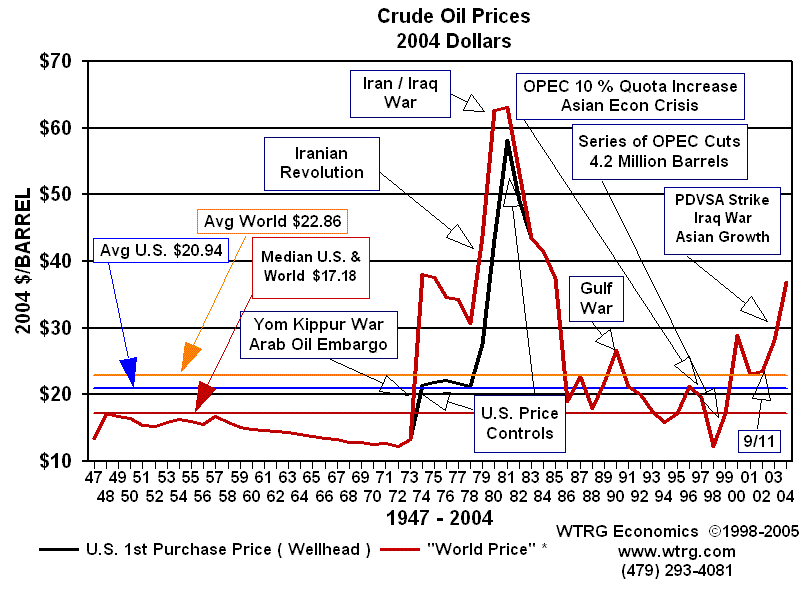
This is true on all counts. Hubbert’s forecasts were made when the U.S. was the world’s dominate oil producer, in an environment of price stability. Until the Arab Oil Embargo in 1973, oil prices were below $20 per barrel (2008 dollars), and declining in real terms.

Rising prices undeniably add reserves. On a micro level, rising prices mean that a well that might be plugged making 5 barrels per day may produce profitably for several more years. Old abandoned wells may even be returned to production. A new prospect that is uneconomic at $40 per barrel may be drilled if prices reach $80.

At a macro level, higher prices extend the search for oil into areas that Hubbert never imagined. Hubbert’s original U.S. projection included no Arctic reserves, as Alaska was not a state when his forecast was made. I’m certain that Hubbert never envisioned drilling in offshore waters over a mile deep, or production from then-worthless shales like the Bakken of North Dakota.

One other point worth mentioning: Hubbert’s work was derived from the “hard-rock” mining industry, which searches for minerals such as gold, silver and platinum. A key difference between these precious metal resources and hydrocarbons. Au, Ag and Pt are elements; they occupy boxes on the Periodic Table.

Unlike elements, natural gas and oil can be created from other substances by alchemy (or, really, by chemical engineering). Gas and liquids can be manufactured from related compounds found in nature, such as coal, tar sands or kerogen. Economics also control the degree to which these technologies expand the effective oil and gas resource base.

Oil resources are not infinite, and it is unarguable that most of the easily accessed, conventionally producible oil has already been discovered. I agree with Yergin’s conclusion, that rather than “Peak Oil” we may be entering a period of “Plateau Oil”. Instead of a symmetric bell-shaped curve, we are on a limb of the curve that flatten or grow slowly for some time. Reserves will be added at the economic frontier, where the search for reserves is justified whenever the marginal cost of finding and developing is less than the current market price. Ultimately, if we let free market forces dictate, new technologies will replace hydrocarbons at such time as they achieve a lower price in the marketplace.

Or, in a more likely scenario, politicians will muck up the whole thing, thinking they will be the first beings in the history of the planet to outsmart the law of supply and demand.

Cross-posted at stevemaley.com.


COMMENTS

  • DerKrieger

    Although I would need to see more evidence I am becoming convinced that oil is in fact not a limited resource and that the earth, via little understood, complicated processes creates oil, the abiotic theory. http://en.wikipedia.org/wiki/Abiogenic_petroleum_origin

    Consider these points:
    Oil being discovered at 30,000 feet, far below the 18,000 feet where organic matter is no longer found.
    Wells pumped dry later replenished.
    Volume of oil pumped thus far not accountable from organic material alone according to present models.
    In Situ production of methane under the conditions that exist in the Earth’s upper mantle. (PhysicsWeb; Sept. 14, 2004)

    If the abiotic theory is correct then there is no peak oil in terms of supply because it is constantly being replenished. There is however peak where the replenishment rate equals the rate of consumption. As oil consumption increases and surpasses the earth’s natural replenishment rate it creates the appearance of decreasing real supply.

    Since we continue to find new supplies, even in the face of a hostile Obama administration, it will take some time to prove or disprove the abiotic theory because the supply of oil vs. the rate of consumption can never reach steady state.

    Bottom line, there is a lot of oil out there and as of now it is only technology and the radical environmental movement that prevent us from abundant supplies and cheap energy.

    • http://impudent.edublogs.org/ kyle8

      methane. Methane is a simple compound found in great abundance in the solar system. So it makes sense that the Earth would have some methane in a super-compressed form within it.

      But I know of no process that would account for the formation of the very complex mixture that is crude.

      • http://travismonitor.blogspot.com Freedoms Truth

        Abiotic oil is almost certainly untrue and/or invalid.

        Most or all of our ‘fossil fuels’ are indeed from biological origin and this can be traced to the source rock.

        Now that nat gas fracking, and even oil fracking is becoming a resource-extracting technology, we have more possible resources of nat gas and oil than we thought.

    • beach91

      I read this book a few years back and anyone interested in the idea that the earth does in fact create oil via the abiogenic theory is simply fascinating! Check it out at Amazon but be prepared, this is like reading a textbook.

  • d_lamar

    In the same way that the earth’s temperature is self-regulating, oil and natural do the same. It probably won’t be proven in my lifetime, for no other reason than that the green crowd and their complicit “scientist” will never admit that the earth was created to be this smart.

    • http://impudent.edublogs.org/ kyle8

      designed that way right?

  • DerKrieger

    …if proven correct would have the added benefit of driving the eco-Marxist Left insane. Why move to their pet alternative energies if natural resources are virtually unlimited and, haha, “renewable”?

  • lineholder

    I think it is typical of liberals to latch onto a scientific theory of this sort and hold on to for dear life as a means of advancing their agenda, no matter how outdated the theory might become.

    I do have a question. In the above article, the relationship between activity, production and costs are referenced. But wouldn’t new technology that influences consumption have to be taken into context as well? Or is that a different subject altogether?

    • http://stevemaley.com Steve Maley

      When that happens, supply & demand find a new equilibrium.

      In fact, our economy produces a dollar of GDP for about half the energy input of 1970 (real dollar terms).

    • http://impudent.edublogs.org/ kyle8

      Overall demand for energy has gone up of course because of millions of once poor people in asia moving up to middle class and demanding more energy using gadgets.

      But the efficiency of our gadgets has increased enormously since the 1970′s.

      • http://travismonitor.blogspot.com Freedoms Truth

        To be more precise, energy use has gone up 1%/yr while GDP has gone up more like 3%/yr. So energy use/GDP is declining, as we become more efficient.

        This has been ongoing for the past few centuries and will continue.

        Bring on the LEDs, high efficient dual cycle gas turbines and fuel efficient cars! :-)

        • YnotNOW

          Is that, even though our efficiency is increasing, that energy use is still rising. This is a good and necessary condition for a growing economy, and a sign that the quality of life is improving across the country (and indeed, in most places around the world).

          This that try to cap or limit the actual AMOUNT of energy use (i.e. cap and trade), are in effect saying that we must cap or reduce economic production. Increased efficiency reduces the rate of increase, it does not elimiate it.

  • Adjoran

    The problem is it is practically impossible to estimate what the limit of recoverable fuel is – as was mentioned in the critque of Hubbert, not only do new technologies emerge for extraction, but also for discovery, and this is not something that is quantifiable for the future.

    For instance, in 1970, the consensus was the world’s recoverable oil supply was 30 years’ worth – assuming the increase in demand would be steady, plus expected inflation. Actual demand increased at more than twice the assumed rate, yet by 2000 we had far more known reserves anyway.

    Hubbert’s shortcoming is shared by the Peak Oil nuts and most of the Left – a devout belief that conditions are static and knowable, when in fact they are not and never have been and never can be.

  • hwgood

    Heck, I’m waiting for them to decide to cure obesity by repealing the Law of Gravity.

    • YnotNOW

      They necessarily bend the time/space continuum and do not have to worry about physical laws (and can dictate human nature, too). :)

  • ihateliberals

    This is the typical “The sky is falling” argument. he was convinced back then that all oil came from dead dinosaurs. he had no idea ht the USA ws ging to run out of oil not because of a lack of it but that the environmentalist would not let it be drilled for. We have sufficient oil now to stop buying 1 ounce of foreign oil most likely forever,

    • edintexas

      Back when Carter screwed things up I had field men knocking at my door wishing to obtain a lease for drilling on my property (along with all the other neighbors for miles around). That was when oil was at $30.00 per barrel and the Enviros and courts weren’t running interference with every attempt to produce energy. Now West Texas Intermediate is still over $80.00 per barrel and there hasn’t been an oil company land man to be seen.

      Admittedly our area is only a low production area, but it still is a known oil producing area. Just not enough to run the gamut of regulations and lawsuits and make a profit, even at $100 per barrel.

  • BA Cyclone

    that the laws of supply and demand are subject to the legislatures.

    They’ll keep trying until that works, dangit!

  • travis690

    You are correct that Mr. Hibbert did not take economics into consideration with his Peak Oil prediction. But the main thing to understand about his thesis is that it did NOT state or imply that oil production would stop; it would only decrease when measured in the same oil fields. It also did NOT state or imply that there would be no further discoveries in other locations. It was entirely based upon known oil fields that were in operation, and measured their expected production (which is based upon economically-realizable prices) in comparison with their life expectancy at that level of production; it then guessed when the tipping point would occur and overall production from these same fields would decrease.

    • http://stevemaley.com Steve Maley

      Hubbert’s oil analysis absolutely did try to estimate the entire resource base, not the reserve base. The yellow portion of the graph in the OP is labeled “Future Discoveries”. He went to considerable effort to assemble ultimate resource estimates from several sources.

      I have read the paper; have you?

      The peak oil work was actually a fairly minor part of Hubbert’s paper. It was done to show that hydrocarbons are finite and we should be concerned about future supply. The bulk of the paper is work to support nuclear energy as the one virtually limitless alternative to “fossil fuels” (oil, gas, tar sands and coal). I wonder why Lefties never point that out, hmm?

    • edintexas

      If there wasn’t even an implication of no further supplies being found, then Hibbert’s view of the world was apparently that of a world of stasis, with all forces cancelling each other out. To not consider that there would be new “finds” is to ignore the obvious and renders his “work” worthless, or at least immaterial and a waste of the taxpayer’s money. Oh, wait. He worked for the US Geological Survey? Surely his view was not that of others at the USGS with regard to oil supply. So he was simply engaged in his own pet work world, without considering any other world might exist. Sort of one definition of insanity, being so single-minded that nothing other than that which you believe even exists.

      • edintexas

        Once again I was interrupted and changed the course of a sentence. Should read “If there wasn’t even an implication of further supplies…”. Oh well.

  • Michael

    Thomas Malthus didn’t figure technology into his predictions and the green revolution destroyed his thesis. Hubberts had an agenda and used flawed theory to try to support it.

    And folks wonder why there’s so many AGW skeptics out there. Behind all the theories is an agenda. People with agendas tend to manipulate numbers to fit their end goal.