






« BACK  |  PRINT

RS

FRONT PAGE CONTRIBUTOR

Natural Gas Economics: A Look Under the Hood

Christmas comes in June for energy geeks and graph junkies. Every year, the Energy Information Administration of the Department of Energy releases its Annual Energy Outlook (AEO), a compendium of 30-tear forecasts and analyses of energy sources and uses. The 212 page .pdf file contains tables, bar charts and area graphs galore, enough to provide blog fodder at least until Christmas (the December one).

This week’s installment is a look at production decline curves from selected shale gas plays. The extreme rates of decline experienced in these wells has interesting and far-reaching policy implications, although this angle is rarely described in the mainstream press. For the energy operator, the performance of his wells in aggregate determine the success or failure of his enterprise. For the nation, shale well performance has become a key factor in energy policy and planning.

Reserves and price projections are the key to everything. I promise to keep this understandable at a general business level.
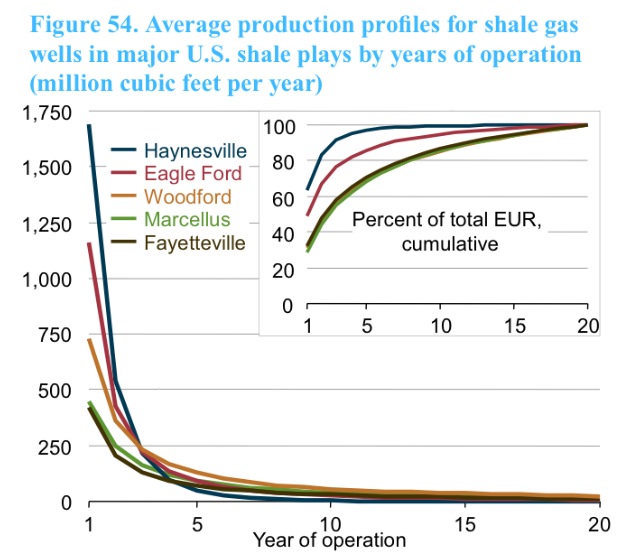
The curves in Figure 54 at left represent averages for five different shale plays; each well is an individual. But what this curve fails to make explicit is the fact that there are very few wells in these shale gas plays with more than four years of history; the rest is projection.

Engineers commonly use decline curves (pdf) as a primary tool for analyzing historical performance of producing wells and forecasting their future performance. The total accumulated past and future production of a well is termed its Estimated (or Economic) Ultimate Recovery (EUR). The EUR of gas wells is measured in billions of cubic feet (BCF). The estimate of future production is termed “remaining reserves”.

Since a resource company’s primary asset is its reserves, these squiggly lines have a lot to do with a company’s financial performance. Truth be told, decline curve analysis can be subjective instead of scientific, particularly early on in a well’s life.  Tight rocks like shales typically exhibit this characteristic “hyperbolic” shape, declining precipitously in the early years; EUR depends on how quickly the rate “breaks over” to a lower, more sustainable rate.

EIA’s Table 17 (click any image to enlarge) shows how reserve estimates have changed in the last three AEOs. In particular, the estimate for average recovery of a well in Louisiana’s Haynesville Shale was 4.59 billion cubic feet (BCF) per well in AEO2010, 3.58 BCF in AEO2011, and only 2.67 BCF per well in this most recent AEO2012. Just as surprising is the inset graph in Figure 54 above, which suggests that a typical Haynesville well produces >95% of its reserves in the first 5 years. The wells produce at phenomenal rates to begin with, but decline rapidly due to the constrained flow properties of ultra-tight shale rocks.

I don’t have any insight on the EIA’s methodology or statistics, but it would appear that as data accumulates with time, the Haynesville per-well reserves have decreased. Back in 2008, Chesapeake Energy made a big splash as the Haynesville pioneer; their estimate at the time was that Haynesville wells would average 6.5 BCF each. (At the time, gas prices were north of $8.00 per mcf at the wellhead.)

All that “flush gas” coming on the market created a temporary glut and drove natural gas prices into the basement. As recently as 2004, energy in the form of gas cost more than the equivalent amount of energy as oil (see Figure 34, left). The horizontal drilling and fracking concepts were first proved in the Barnett Shale of Texas; the phenomenal early success in the Haynesville in turn ignited shale plays in across the country, and now those ideas are spreading internationally, too.

How big a difference does all this make? For an energy company, it is all about reserves x price; when one or both goes south, it is bad news. When you produce disappointing reserves into declining price, it can be disastrous.

The table at right is a grossly simplified look at the economics of developing the EIA’s typical well from the 2011 and 2012 studies. Gross revenue is reserves times price; in this example the gross revenue for a 3.58 BCF well, given $4.50/mcf gas prices (early 2011 prices) over the well’s life would generate  $16.1 million in gross revenue (far right column). After deducting landowner royalties, state severance taxes and lease operating expenses, the owner’s net is almost $10.8 million, enough to repay the assumed $7.5 million cost to drill and equip the well and leave a $3.3 million profit. (This analysis ignores overhead, income taxes and the time value of money. It also ignores the up-front cost of the lease, the rights that allow the driller to drill, which can be very significant.)

But if the well’s performance disappoints and the reserves turn out to be 2.7 BCF (per AEO2012) instead of 3.6 BCF, drilling becomes a breakeven proposition, even if the price hangs in at $4.50. With the price falling to $2.50, it’s a disaster. The operator takes home only 50¢ on $1.00 of his initial drilling investment. That’s called “destroying value”, and it doesn’t matter if you’re an oil man, a shoe salesman or a chicken farmer, you understand that that’s bad for business. (Politicians may not get it, and there’s not a lot we can do about that.)

Operators have mostly responded rationally to the current oil/gas price situation. The Haynesville produces “dry gas”, i.e. without associated liquid hydrocarbons. A modest amount of oil or condensate produced along with the gas can radically alter drilling economics. Consequently, most operators have refocused their attention away from the Haynesville and other dry gas plays to gas/condensate plays like the Eagle Ford of south Texas or to pure oil plays like the Bakken of North Dakota. In the Eagle Ford, the gas price matters little because the economics are totally driven by the condensate.

Historically, 60-70% 0f domestic rigs targeted gas. Now, only 25% of the rig fleet drills for gas.

Long term trends? I look for the historically wide price spread of gas vs oil to close somewhat. Few operators will be able to deliver gas to the market profitably under the current price regime.  We have already seen the total production curve for the Haynesville peak and begin to decline.

Is this the end of the “shale bubble”? Hardly. The shales are everywhere. Each one has different characteristics and a different breakeven price.

I suspect that price stability in the $4-$5 range would support an active gas drilling industry. Even at that level, gas would still provide a huge price advantage compared to gasoline as a transportation fuel.

Natural gas is clean, abundant and American; it makes up nearly 25% of our nation’s total energy consumption. Of the fuels in our energy mix, gas is the most versatile, useful for electrical generation or for transportation. Domestic drilling is a true, private sector “shovel ready” jobs program that could be kicked into high gear overnight without tax credits and DoE loan guarantees.

Cross-posted at Maley’s Energy Blog.


Get Alerts

COMMENTS

  • skorrent1

    To “re-frack” a well that has run dry to tap more gas that wasn’t opened up the first time?

    • ohiohistorian

      A partial answer

      http://www.rpsea.org/attachments/contentmanagers/3458/07122-41-Re-fracturing_of_Tight_Gas_Shales%E2%80%93UT_at_Austin.pdf

  • Wubbies World

    I added an entry onto the Wikipedia page. I am not sure if it will stay there but I thought I would pass along this interesting tid bit:

    At the state capital building for the state of South Dakota, an eternal flame fountain next to the capital lake is fueled by natural gas that is naturally seeping from the below ground rock formations. No “fracking” has occurred anywhere in the vicinity and the cisterns below the fountain that trap the gas and funnel it up into the fountain head has been in use for years, even before “fracking” was invented and therefore is provably not responsible for its natural occurrence. The cisterns have begun to rust because they are made of iron and have been underground for such a long period of time. The fountain flame has become sporadic in recent years because of the corrosion but the gas is still present. The gas is just not focused in the fountain head any longer. Discussions in the state legislature have occurred asking about the feasibility of replacing the cisterns. However, throwing a lit match into the water will relight the flame on the water for brief periods.

    The web page to see the fountain memorial is here: http://www.state.sd.us/boa/CapitolTour/fountain.htm

    Frack Nation could learn something here.

    • http://stevemaley.com Steve Maley

      As Fracknation points out, there are towns called Burning Springs in WV, NY & KY whose burning springs predated gas drilling.

      CA has oil seeps. The most famous is the La Brea Tar Pits.

      • citizenkh

        was discovered via oil in the fresh water of cattle troughs on the Gray Ranch south of Vinton, LA.

        At time of development it was the highest producing field in the country. No wonder Matilda Gray became the wealthiest woman in the U.S. by 1970, oil and a great business mind.

        • duncer

          The sierra club would sue God to stop his mixing gas and water if they could find a court to grant injunctive relief and if they believed in God.

      • Wubbies World

        ….frustrating. However, the agenda driven environmentalists do everything in their power to ignore what is right before our eyes. As long as it helps them get what they want the facts are unimportant. I guess this falls in the same category as the global warming crowd ignoring the entire “middle ages warming period” to further their agenda.

        It is maddening stuff.

        That eternal flame fountain is 2 miles from my house. I see it almost everyday as I go to and from work.

        One side note: It looks like the Bakken shale drilling is about to make its way into South Dakota too. It is nice to see the people here are happy about it. They communities out west are holding meetings about how to plan for the growth already.

        • renl57

          …is that it’s so abundant and cheap that it’s preventing wind and solar power from becoming competitive.

          “The emergence of natural gas as a significant part of our energy mix is particularly frightening, because it dangerously postpones investment in clean energy at a time when we should be doubling down on wind, solar and energy efficiency.?
          ?Robin Mann, Sierra Club President

          That’s a tacit admission that wind and solar power will only become widely used if every other type of energy is banned first.

          • notpropagandized

            Environmentalists are not reall environmentalists. They are socialist/communist/govtbureacracy types that use environmentalism as their Trojan Horse for government usurpation of spending and public policy control. The only real “environmentalists” are private conservationists and preservationists that require results. Environmentalists do not require results apart from diverting private wealth and resources into government spending and policy control.

            Solar and Wind can only exist if government takes private resources and subsidizes these uneconomic enterprises that enter a crony relationship with government, siphoning private wealth and sharing it in goverment apparatcik. Solar and Wind will NEVER offer the BTU equivalent of fossil fuels.

            By the way, as a core conservative and conservationist, I really resent that all these wind turbines keep swatting various raptor species out of the air, especially during spring an fall migration.

          • justperhaps45

            I remember when my Mom would rush to gather the clothes drying on the line in the backyard if rain impended. Her reason? Not because the clothes would get wet but because they would get dirty. She knew that rain was not only for the distribution of moisture, it was also God?s method for cleaning the air. I suspect that the other natural forces the Greens are bent on harvesting may also have multiple purposes.

            Wind may cool the earth, increase evaporation and therefore rainfall, normalize air content so trace materials are usefully distributed instead of concentrated and may fail to do it?s purpose as effectively if slowed by windmills. Sunlight may actually warm the earth appropriately in locales that need the heat but may overheat areas where inefficient collectors are creating imbalance. My point? Not that harvesting is bad but that understanding needs to go deeper. Shallow solutions are for the superficial and seldom stand the test of time.

          • notpropagandized

            It’s amazing that political ideology does not determine a person’s insensitivity to consequences of actions while it seems personality types are more predictive. Most truly environmentally concerned persons I know are conservatives, but don’t spend much time around liberals since their brains don’t work very wall at all. Such a shame.

            We know so much about farming for instance, but farmers still try and learn all the intricate causes and effects, but they often elude them.

            I still have huge problem with seeming hypersensitivity to carbon dioxide in our atmosphere when it clearly promotes plant growth in greater concentrations. That it is now a pollutant is a source of unceasing irritation. Why not go back to watching out for the real dirty stuff.

  • citizenkh

    seems to have two zones of production, an upper chalk zone and a lower shale zone. At least that is what a partner is some several hundred acres of land is telling me.

    It also seem that the Tuscaloosa Marine Shale, in Louisiana and part of Mississippi is producing decent flows from the chalk formation above the shale.

  • citizenkh

    the midstream pipeline company operates the gas processing facilities which remove the NGL’s (natural gas liquids) from the produced natural gas streams.

    Are the producers obtaining higher prices, or share in some of the profit from sales of the NGL’s?

    Are not the production companies selling wellhead natural gas to the pipeline companies?

    • http://stevemaley.com Steve Maley

      …is required in most gas contracts. The producer gets the benefit of increased revenue since the BTUs are worth much more as liquid vs gas. The operator of the gas plant gets a cut of the liquids as his revenue stream.

      Unprocessed high BTU gas would drop out those liquids in the transmission lines & cause all kinds of problems.

  • norris

    The only sure way to stop oil seeps and keep natural gas out of the water supply is to get the oil and gas out of the ground We must burn it to dispose of it properly.

    • justperhaps45

      Keep those thoughts out of the box.
      Innovations are the droppings from flights of fancy.

  • ihateliberals

    My eye’s are glazed over now and I have a headache.

    • http://stevemaley.com Steve Maley

      ~

  • MF

    “Every year, the Energy Information Administration of the Department of Energy releases its Annual Energy Outlook (AEO), a compendium of 30-tear forecasts and analyses of energy sources and uses.”

    Yeah, I think it really is a 30-tear forecast, based on Obama’s team’s policies. In fact, 30 tears may not be enough to cover the pain we’re feeling from them!

  • justperhaps45

    Are government forecasts ever on target?
    What might the target really be?
    Are forecasts straws in the wind?
    Does anyone really care except the imagineer who is paid for musing?
    Are they a market creation device?
    Don’t they often give imaginary direction?
    Is that black dot in the middle of the target, a dot, or is it really a black hole?

    • http://stevemaley.com Steve Maley

      The answer is blowin’ in the wind.

  • justperhaps45

    Are government forecasts ever on target?
    What might the target really be?
    Are forecasts straws in the wind?
    Does anyone really care except the imagineer who is paid for musing?
    Are they a market creation device?
    Don’t they often give imaginary direction?
    Is that black dot in the middle of the target, a dot, or is it really a black hole?

  • Pingback: hier

  • Pingback: Cinderella Zartman

  • Pingback: Tiana Knepper

  • Pingback: electronic cigarette

  • Pingback: cleaning services for office

  • Pingback: Welcome to My Blog

  • Pingback: their explanation

  • Pingback: zakopane noclegi

  • Pingback: distilling tequila

  • Pingback: Sizegenetics testimonials

  • Pingback: Magician

  • Pingback: Portal randkowy

  • Pingback: wzór cv

  • Pingback: Wedding ideas

  • Pingback: Investment Opportunities

  • Pingback: Clicking Right here

  • Pingback: แทงบอลออนไลน์

  • Pingback: แทงบอล

  • Pingback: distilling scotch

  • Pingback: wikipedia reference

  • Pingback: Koi

  • Pingback: descargar musica gratis navideña español

  • Pingback: check my weblog

  • Pingback: foreclosure

  • Pingback: Koi

  • Pingback: distilled water

  • Pingback: at Msn

  • Pingback: Brock Bonning

  • Pingback: Ashley Hastie

  • Pingback: Pool Shop

  • Pingback: Jenette Hovi

  • Pingback: estar de acuerdo con

  • Pingback: Video on Demand

  • Pingback: furniture reglue

  • Pingback: cheap baby shower favors

  • Pingback: กล้องวงจรปิด

  • Pingback: buy wow gold

  • Pingback: released here

  • Pingback: Shu Cavalaris

  • Pingback: Dominique Macaskill

  • Pingback: umow sie na randke

  • Pingback: znajdz milosc

  • Pingback: Aquariumfilter

  • Pingback: winter park kitchen remodel excel spreadsheet

  • Pingback: Payday Loans Online

  • Pingback: randka

  • Pingback: Zelda Vanostrand

  • Pingback: Kathy Wahington

  • Pingback: umow sie na randke

  • Pingback: randki za darmo

  • Pingback: PPT

  • Pingback: final cut pro x tutorial

  • Pingback: Kory Bro

  • Pingback: http://theprodigyfanboy.com/2010/12/05/warriors-dance-far-too-loud-refix-free-download/

  • Pingback: drawing and painting courses

  • Pingback: 2 bay network storage

  • Pingback: recommended brand development

  • Pingback: distill synonym

  • Pingback: how to cure a yeast infection at home while pregnant

  • Pingback: long term care facilities

  • Pingback: do you agree

  • Pingback: darmowa strona randki

  • Pingback: articles

  • Pingback: fix my pc

  • Pingback: randki internetowe

  • Pingback: umow sie na randke

  • Pingback: Arkadas Ara

  • Pingback: randka przez internet

  • Pingback: management

  • Pingback: strona z randkami

  • Pingback: music producers

  • Pingback: see site

  • Pingback: SEO Services Australia

  • Pingback: payday loan online

  • Pingback: casino gaming

  • Pingback: Investment Opportunities

  • Pingback: Penny Lu

  • Pingback: http://www.24-7pr.com/press/kinds-of-ladies-equipment-and-why-just-about-every-modern-day-female-ought-to-opt-for-them.html

  • Pingback: Roberta Benzel

  • Pingback: dry cleaner

  • Pingback: star wars 7 director

  • Pingback: Linnie Cundy

  • Pingback: wealth through internet marketing

  • Pingback: Troy Nesti

  • Pingback: organizzazione matrimoni toscana

  • Pingback: madden 13 tips

  • Pingback: this specific good function

  • Pingback: Media Streaming

  • Pingback: for new persons

  • Pingback: funny jokes twitter

  • Pingback: Destinee

  • Pingback: Guy

  • Pingback: Reed Majeske

  • Pingback: Katherina Ebbesen

  • Pingback: Jack Taylor

  • Pingback: please

  • Pingback: gold and silver investments

  • Pingback: Jim Dannatt

  • Pingback: Carlo Wydeven

  • Pingback: this we seriously regarded

  • Pingback: Darwin Glatt

  • Pingback: alfileres de novia

  • Pingback: Lala Vakil

  • Pingback: Sam Lukasik

  • Pingback: Diseño web barato

  • Pingback: home electronics

  • Pingback: Lacy

  • Pingback: Chase

  • Pingback: Lacy

  • Pingback: Betsey Hons

  • Pingback: Susan Saumier

  • Pingback: Its lowers cholesterol

  • Pingback: Destry

  • Pingback: sofy rozkładane

  • Pingback: Jenee Sauceman

  • Pingback: las vegas bankruptcy

  • Pingback: Zoila Houck

  • Pingback: norway online casino

  • Pingback: Jeremy Goettel

  • Pingback: xenon

  • Pingback: Delfina Kritikos

  • Pingback: Jacquelin Tamplin

  • Pingback: Bari

  • Pingback: Gita Eppard

  • Pingback: Leticia Delmont

  • Pingback: Janyce Frees